Monday, February 18, 2013

Tuesday, September 18, 2012
Sunday, May 20, 2012
Not For Profit in the Elysia Commons
How Charities Engage
The Elysia Commons is an association of organisations. It was created to solve a number of common problems that organisations often face, and also to support health in organisational life by promoting development, collaboration and discernment.
Anthroposophy is a source of inspiration and guidance for the Elysia Commons, and through the Elysia Commons it makes a contribution, along with other modern perspectives, to the renewal of capitalism.
For Profit in the Elysia Commons (For Profit in the Elysia Commons) explores the flow of money from the perspective of Rudolf Steiner's Three Fold Social Commonwealth. This paper explores organisational life from the insights that Rudolf Steiner brought of freedom and the Spiritual Hierarchies... Not for profit in the Elysia Commons
The Elysia Commons is an association of organisations. It was created to solve a number of common problems that organisations often face, and also to support health in organisational life by promoting development, collaboration and discernment.
Anthroposophy is a source of inspiration and guidance for the Elysia Commons, and through the Elysia Commons it makes a contribution, along with other modern perspectives, to the renewal of capitalism.
For Profit in the Elysia Commons (For Profit in the Elysia Commons) explores the flow of money from the perspective of Rudolf Steiner's Three Fold Social Commonwealth. This paper explores organisational life from the insights that Rudolf Steiner brought of freedom and the Spiritual Hierarchies... Not for profit in the Elysia Commons
Wednesday, April 18, 2012
Participative, Michaelic Leadership
The basic idea is to work through groups based discussion processes. There is a simple dynamic: agree -> act -> review.

The meeting establishes the evidence and makes decisions. The key task is always prioritisation. List are maintained. These are "Project" and "Action" Lists for ongoing work and "Safe Spaces" lists for projects and ideas that can not be done yet.
Michaelic implies accountability. Participative implies collaboration. On the one hand everything is decided together, or in different but appropriate togethernesses. On the other hand the management is authorised to make sure the agreements are carried out.

Modern leadership requires thinking, feeling and willing. The thinking aspect is what people usually mean by the narrower meaning of "Leadership". Think of a group of people on a hike. Across the bog is a mountain. The leadership is to say "let us cross the bog to the mountain", the management is the job of getting everyone across the bog together, then up the mountain. On the way different obstacles will call forth leadership moments.
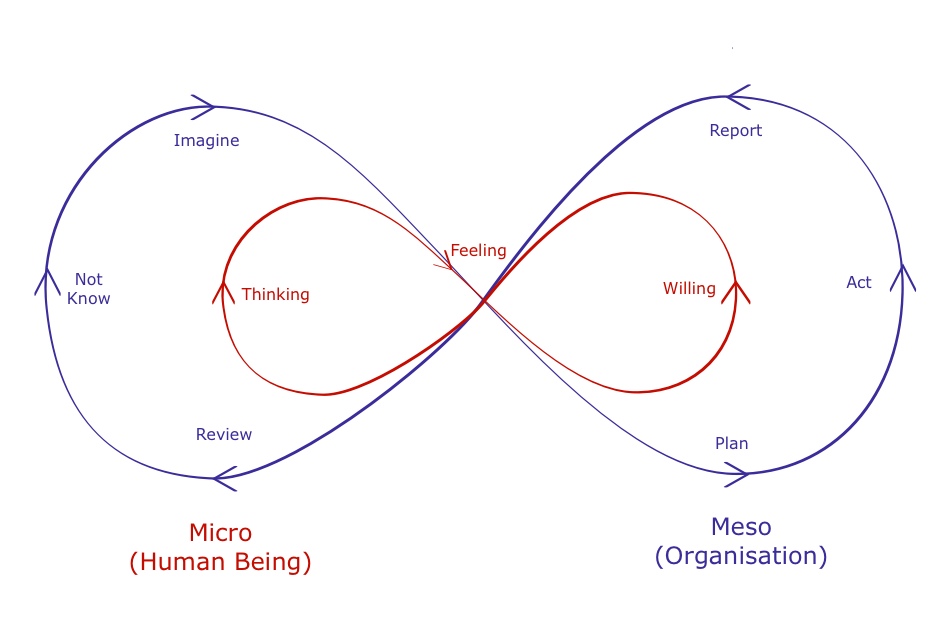
The meeting establishes the evidence and makes decisions. The key task is always prioritisation. List are maintained. These are "Project" and "Action" Lists for ongoing work and "Safe Spaces" lists for projects and ideas that can not be done yet.
It's all inspired by Anthroposophy, and built up from Thinking Feeling Willing. We might call it Participative, Michaelic Leadership.
Michaelic implies accountability. Participative implies collaboration. On the one hand everything is decided together, or in different but appropriate togethernesses. On the other hand the management is authorised to make sure the agreements are carried out.
Here is another thought movement diagram.

Modern leadership requires thinking, feeling and willing. The thinking aspect is what people usually mean by the narrower meaning of "Leadership". Think of a group of people on a hike. Across the bog is a mountain. The leadership is to say "let us cross the bog to the mountain", the management is the job of getting everyone across the bog together, then up the mountain. On the way different obstacles will call forth leadership moments.
We have a new thought, supported by research out of practical Anthroposophy, that there is a middle task, Facilitation. In order for the leadership - management axis to be effective, a facilitation process is required.
So the groups meet in layers of increasing executive duty. Starting with the board or ownership container and ending with the executive or departmental meetings.
All the time facilitated discussion is working towards agreements that, once made, are then held to account for being carried out as agreed.
Facilitation Techniques:
Steps 4 and 5 were inspired by Edward de Bono and many other business gurus.
In terms of working together in organisations we might experience the first verse, Spirit Recollection, to be about reviewing. The third, Spirit Meditation about decision making, and the fifth, Spirit Vision about planning.
The middle verse, decision making / Spirit Meditation is also the place where our meetings are managed. In that regard, the emotions that well up and have to be contained in order that good work is achieved, can be thought of in terms of glimpses of the "surging deeds of world evolution...", and the result is: "Unite thine own I with the I of the world". In other words, our planning is woven, through the decision, in to the carrying out of the Will, thus the world is transformed, or made.
So the groups meet in layers of increasing executive duty. Starting with the board or ownership container and ending with the executive or departmental meetings.
All the time facilitated discussion is working towards agreements that, once made, are then held to account for being carried out as agreed.
Facilitation Techniques:
- Gather evidence first and carry on gathering until you can't bear it any longer.
- Then ask what the solution might be.
- Give everyone a voice, and unless they are inputting data, an equal voice.
- Check in how people feel at the start, end and in between if it is a big process.
- Try to write it up as you go. At key points, read back for agreement.
- Every decision is made when everyone feels it is right. Not thinks it is right. If a majority decision, then it is because a majority felt it was right. Decision making is "Founding with our Hearts" and has to be feeling based, after thoughtful deliberation.
- When checking if actions are carried out (accountability), it is all about what was done. This step is "what we would direct with our heads".
Steps 4 and 5 were inspired by Edward de Bono and many other business gurus.
Steps 6 and 7 are inspired by The Foundation Stone Meditation, R.Steiner.
The Foundation Stone Meditation
The Foundation Stone Meditation is a practical guide that encompasses the whole of Anthroposophy. Many have taken it in to their lives and have found it helpful in many ways.In terms of working together in organisations we might experience the first verse, Spirit Recollection, to be about reviewing. The third, Spirit Meditation about decision making, and the fifth, Spirit Vision about planning.
The middle verse, decision making / Spirit Meditation is also the place where our meetings are managed. In that regard, the emotions that well up and have to be contained in order that good work is achieved, can be thought of in terms of glimpses of the "surging deeds of world evolution...", and the result is: "Unite thine own I with the I of the world". In other words, our planning is woven, through the decision, in to the carrying out of the Will, thus the world is transformed, or made.
Saturday, April 7, 2012
For Profit in the Elysia Commons
This paper provides Anthroposophical insights into how commercial, for profit, organisations belong to the Elysia Commons.
The Elysia Commons brings organisations who share a common purpose in to association so that they can gain competitive advantage. The types of organisations and the way in which they associate are many and varied, from charities to not-for-profit businesses, from commercial organisations to educational institutions.
This document explores the particular way "for profit" organisations can be knitted in to the Elysia Commons and explains the reasoning behind the method.
For the full paper, click here: For Profit in the Elysia Commons
Sunday, October 23, 2011
Thinking, feeling, willing in action
I have, over recent months, been much struck by three themes that my colleague Bruce Irvine of the Grubb Institute has been working with. Recently I wondered how they might be connected.
The first theme I noticed was the spirit of enquiry, and I particularly noticed this in the context of whether or not one felt curious. The loss of curiosity being a sign of having given up. I like to think of the phrase in terms of a spiritual "Spirit" called "Enquiry". A member of the family of Spirits whose most exalted member, the Holy Spirit, leads and contains all the others. The task of the Holy Spirit to be the relationship between, to be the flow of love and of grace. The task of the Spirit of Enquiry being the discernment of all that is, right here, right now, including, what is present of the future, emergent in this moment. Of spirit substance, the Spirit of Enquiry is thinking in action, it is Goethean observation.
The second theme is co-creation. Distinct from creation, co-creation highlights the deeper reality that all that is, is, because together we have made it so. The concept of co-creation precludes the possibility that we are victims of the other and insists that we have it in our gift to change our own behaviour in order that what is co-created becomes truer to our purpose. This concept struggles to be comprehensible, or even seem fair, until the concepts of pre-birth intention, karma and freedom are brought to bear. Co-creation is mobilised Will.
The third theme is self-authorisation. Just as co-creation reframes creation to include others, so self-authorisation reframes authority, once again frustrating attempts to attach blame for consequences to anyone else but oneself. I act because I choose to, because I authorise myself to act. The moment of commitment, of taking up ones own authority, is a threshold, and we only cross when it feels right. Self-authorisation is achieved through feeling mobilised in freedom.
Thus we se that, in freedom, our thinking, feeling and willing are put to work, enquiring, judging the rightness of decisions, and accepting responsibility for our part in all that comes about.
Monday, October 17, 2011
Meetings
I have noticed something that I find interesting about meetings. There are two sorts of productive and work related activities that occur during most work based meetings, making decisions and hearing reports. The observation is really very simple and it is a connection between the Foundation Stone Meditation (FSM) and these two aspects of meetings.
Tom Ravetz has written about the FSM and brought to my attention that it bounces back and forth between the human and the cosmic, the micro and the macro. This continues for the first six verses and then in the 7th the human being is brought in to focus in a new way, through the naming of roles: shepherd and king, two polar positions in society that encompass everything in between.
Then in the 8th verse it is back out to the cosmos with an appeal to Christ to warm our hearts and enlighten out heads so that good may become. This is a development from the 7th verse with the human beings being brought in to motion, to carry out action such that good will be brought in to the world.
However, it is the last 3 lines that really show the way:
What with our hearts we would found
What with our heads we would direct
With single purpose
When human beings work together they have the opportunity to let good become together and it is in social sphere in which we engage and work together. The social sphere is the creation of the human beings, we create it ourselves, and it the mesosphere or middle sphere, between the micro and macro. This is the location of our activity and to a very great extent it is through meetings that our activity comes about.
It was thinking about this that I realised I could understand these last three lines as a simple guide to how to run meetings:
Well made decisions will feel right for everyone
Attentive listening and penetrating questions will deliver healthy accountability
And use the organisation purpose to judge decisions and performance
Which makes a lot of sense and corresponds to my experience.
Tuesday, August 16, 2011
Elysia Commons In Practice
An early paper discussing how the Elysia Commons will work
The Elysia Commons is a container that supports organisations that are united by a single purpose. The purpose is:The Elysia Commons meets human beings’ yearning for meaningful work by creating and sustaining a successful ecosystem of organisations that have an ethos of purposeful, accountable activity.
One concrete principle is transparency. All formal reports are public, everything is transparent, and the information is contained in a central elysia.org website.
Around the outside is a partnership that everyone who is a co-worker in any organisation in the Commons belongs to. No profit is distributed. As the Commons is forming leadership will be held by Sebastian Parsons as Founder, but once it is established then leadership will move from the Founder to a democratic body elected by all the Partners (co-workers) of the Commons, see below for more details.
The Elysia Trust is to be created and will be a charity. This Trust will support organisations in the Commons, the Commons itself (for training, PR and so on), and will be funded by profits that the Elysia Commons’ organisations may choose to direct to it, plus whatever other funding it may attract or generate. This process, in the sense of Steiner’s three-fold, is a mechanism for money to die out of the economy through consumption in charitable activity.
Case Study – The Elysia Consortium of Social and Therapeutic Renewal
A number of therapists some of whom used to work at Park Atwood and were inspired by its therapeutic model, got together after PA closed in order to create a therapeuticum in Stourbridge. In the process they formed a consortium of health care professionals and were the first organisation to be founded in the Elysia Commons.
The group meet every month to manage the Consortium, to develop the Therapeuticum and for a Bible Evening in which the Being of this organisation is nurtured.
The flip chart image shows the Elysia Commons (called Elysia Org at the time of the creation of the flip chart) with the various different organisations in it. The arrow at the top right shows the single purpose that all organisations have in common. The blue writing at the top and bottom relates to the purpose of the Elysia Consortium of Social and Therapeutic Renewal.

Case Study – Elysia Company
The Elysia Group is the distributor of Dr.Hauschka in the UK and the owner of the Liv organic clothing brand. It also owns Rush Farm, a 200 acre biodynamic farm in North East Worcestershire, and Stockwood Business Park, based on Rush Farm. The Elysia Group is the company co-founded and run by Sebastian Parsons.Case Study – Commercial Services
It is planned to have a commercial services company which will be dedicated to the task of keeping financial records, producing financial management information, managing HR tasks and supporting other routine administrative matters.Services include:
- Finance
- HR
- Administration
- IT
- Reprographics
- Leadership training
- Elysia Life co-worker magazine
- elysia.org website
- PR (PR is co-ordinated at the level of the Commons, even if it is delegated to different teams throughout the system for different tasks)
Elysia? What’s in a name?
Elysia stands for meaningful work and indicates a committed to a values driven organisation. The name Elysia can be added to an organisation with agreement of the Elysia Commons, but an organisation does not get to, or have to add the name “Elysia” just because it has joined the Commons.Governance of the Commons
The task of the Commons is two sided. On one side it has to contain and support, and on the other side is the activity of holding to account, to their own purposes, the contained organisations. It has an executive that supports the activity of the organisations. It has specialist legal expertise for supporting the creation of all the partnership and commercial agreements and it has marketing expertise for the newsletter (inner), website (inner and outer) and PR (outer) tasks.As part of the negotiation before an organisation joins or is created decisions are made about the relationship with the Commons. This includes whether or not there will be any ownership and if so the way in which that ownership will operate. Agreements may also need to be made to facilitate the use of the “Elysia” name if that was desired.
After the initial founding phase a Council is to be elected by a democratic process from the Commons Partners. This Council is then re-elected every 5 / 7 years thereafter. The power that the Commons has in each organisations life is strictly limited, as the highest sanction is of leaving the Commons, and that is only as powerful as the Commons is effective.
Possible Organisation of the Governance Process
The Council has 12 seats including a chairman. Any Commons Partner can put their name forward for Council membership and to be the Chairman. The names are then put to the members. The election also elects the chairman, who has a casting vote. If there is a tie for the election of the chairman then the elected Council members get a second vote, if there is another tie then a coin is tossed. If there is a tie in the Council Elections then the Council can be larger.Certain things, like the Commons’ Purpose Statement require a vote of the whole membership and require a 90% agreement to be carried. These rules are laid down in the partnership agreement of the Commons.
The Council meets 4 times a year. Council decisions only become “formalised” when signed off by a person who has a role called "President". The remit of the Council is the operation of the Commons, not the organisations within. This includes the actual partnership agreement of the Commons. All Council members must be co-workers in contained organisations. Training is developed to support Council members in understanding and carrying out their roles.
When the President steps down he appoints a single successor, who must be approved by the Council. The President is the ultimate container of the whole system, but has strictly formalised power and is therefore principally a figurehead, with a certain amount of ultimate power that gives the role relevance. This role has a sting like a bee such that if the President refuses to sign a decision off then this triggers an election process of the President and the Council. Presidents are appointed for an indefinite period. If no successor is appointed then the President is elected. If the President overturns a decision of the Council then that will force an election for the successor.
The way the function of Ownership is held in more and more peripheral containers feels a bit like looking out of a railway carriage at night with the carriages reaching out in to the darkness. Each layer of containment, the organisation, the Commons Partners, the Commons Council, the Chair of the Commons and the President or the Founder is in a flow of accountability, back and forth. As the containers stretch outward the capacity of the power to act changes until at the outer extreme there is a certain element of dis-interest, and a strong element of self-sacrifice required if the power is to be mobilised. This force is balancing the executive forces radiating out from the centre and filling the container with activity. See the paper called “Leadership and Power” by Sebastian Parsons, 16/8/2011.
With this self-balancing structure, no matter how big the Commons becomes, the system will be able to accommodate it. If there were loads of schools, hospitals, doctors surgeries, the university, arts organisations etc then the Council would become bigger and meet more often. If it works that well then there is likely to be other organisation that set up and compete. Which is ideal.
Legal Basis for the Elysia Commons
A key principle of the Commons concerns the legal basis for the Commons, which is knitted together by agreements, and which will inevitably result in disputes occurring when agreements are not lived up to. In all legal matters the Elysia Commons sits in the national legal system and processes of England. The contracts that exist within the system are controlled by the national legal system and so justice within the Commons is delegated outwards to the national container. This is in accord with the fundamental principles of the Rights Realm and a prerequisite for good organisational health.Leadership and Power
I often hear that people do not believe in “hierarchical leadership”, and are strongly opposed to it. Effective leadership is a core value of the Elysia Commons and this paper sets out some thoughts on the subject that seek to define the terms to allow the discourse to develop.
For I perceive there to be a danger that this statement paralyses our Will through the difference between “leadership” and what is meant by “hierarchical leadership” not being clear. The statement “we don’t believe in hierarchical leadership” is so strong that in the presence of any doubt at all, the concept of Leadership, as a whole, becomes forbidden.
Firstly I would like to differentiate ownership from control. Ownership is the ultimate container and determines how control will deploy.
Control directs the activity of the organisation by deploying authority and through the authority flows the power of the human beings as they carry out their tasks.
Power deployed in directions that are not authorised is essentially abusive. This can easily occur, particularly when power gets conflated with position and status becomes primary.
Perhaps “hierarchical leadership” has become a codeword for when power is wielded in an organisation in accordance with status instead of authority.
There is nothing in the research in to the Hierarchies to suggest that authority does not flow through a hierarchy. There is also nothing in the way that Steiner founded the Anthroposophical Society to suggest that he did not believe in leadership. On the contrary, the big decision for Steiner himself was whether to directly take up leadership of the organisation or not.
Our research in to the Hierarchies leaves me with a sense of order and task, of each Being knowing its task and taking it up fully. In Earthly life, in our organisations, we access our tasks through our roles.
It is interesting to notice that when authority is assigned to the role rather than the person it provides a layer of separation from the person, which is effectively a buffer against the power of the authority seeping through to the person and becoming power mobilised according to status.
Role offers us a critical frame to view ourselves through, because through that frame we can catch sight of ourselves, our system and the context of all. We can clearly identify our authority, from whence it originates and to where it will flow through us.
 It can be seen in this diagram how the ownership is a peripheral force that works inwards and will suffuse the organisation with a particular atmosphere, and that the leadership / management of the organisation is a force that works outwards and permeates the organisation through the paths and channels of authority.
The Elysia Commons offers to support the forces of ownership in properly containing the organisation, suffusing it with a healthy atmosphere, which will in turn support the forces of leadership in permeating the organisation with healthy authority, to foster effective, competitive action.
For I perceive there to be a danger that this statement paralyses our Will through the difference between “leadership” and what is meant by “hierarchical leadership” not being clear. The statement “we don’t believe in hierarchical leadership” is so strong that in the presence of any doubt at all, the concept of Leadership, as a whole, becomes forbidden.
Firstly I would like to differentiate ownership from control. Ownership is the ultimate container and determines how control will deploy.
Control directs the activity of the organisation by deploying authority and through the authority flows the power of the human beings as they carry out their tasks.
Power deployed in directions that are not authorised is essentially abusive. This can easily occur, particularly when power gets conflated with position and status becomes primary.
Perhaps “hierarchical leadership” has become a codeword for when power is wielded in an organisation in accordance with status instead of authority.
There is nothing in the research in to the Hierarchies to suggest that authority does not flow through a hierarchy. There is also nothing in the way that Steiner founded the Anthroposophical Society to suggest that he did not believe in leadership. On the contrary, the big decision for Steiner himself was whether to directly take up leadership of the organisation or not.
Our research in to the Hierarchies leaves me with a sense of order and task, of each Being knowing its task and taking it up fully. In Earthly life, in our organisations, we access our tasks through our roles.
It is interesting to notice that when authority is assigned to the role rather than the person it provides a layer of separation from the person, which is effectively a buffer against the power of the authority seeping through to the person and becoming power mobilised according to status.
Role offers us a critical frame to view ourselves through, because through that frame we can catch sight of ourselves, our system and the context of all. We can clearly identify our authority, from whence it originates and to where it will flow through us.

The Elysia Commons offers to support the forces of ownership in properly containing the organisation, suffusing it with a healthy atmosphere, which will in turn support the forces of leadership in permeating the organisation with healthy authority, to foster effective, competitive action.
Thursday, August 11, 2011
The Elysia Commons
What is the Elysia Commons?
The Elysia Commons is an ecosystem (association) of organisations that provides benefit to the organisations and the people working in them. It is supportive in all that each one has in common, and it sharpens all that is particular in each one. In consequence, it offers competitive advantage against other organisations in society. The Elysia Commons actively encourages organisational effectiveness through applied values.
In this diagram the Commons is shown weaving between the co-workers and the organisations. This engagement of the co-worker in something bigger than the organisation allows the co-workers to take up a higher perspective that can deepen understanding, a sense of ownership and motivation. On the other hand, it also allows the member organisations to engage with the “spiritual physics” of ownership in innovate ways that open up freedom and engagement.
Competitive Advantage
Organisations are the creatures of the mesosphere , that sphere which man generates in the course of his own activity in collaboration with others. These “creatures” all represent different ideas, and through the competition between the organisations, the different ideas strive, evolve, compete. Thus society itself evolves and in it the human being too.The Elysia Commons embodies a particular idea, the idea that there is meaning to life. This idea is embodied in the Purpose Statement in a way that is relevant to the activity of the Commons, the activity of being an organisation.
An organisation is an organism of the mesosphere ( from macro = big, micro = small and meso = middle). It is a contained activity directed to a single purpose. It is made of people working together.
Purpose Statement of Elysia Commons
The Elysia Commons meets human beings’ yearning for meaningful work by founding and sustaining an ecosystem of organisations that have an ethos of purposeful, accountable activity.The Administration of the Elysia Common
Organisations join the Commons through an application process. The key to being accepted is to have a Purpose or Mission that aligns with the purpose of the Elysia Commons and to convince the Commons Leadership Group that your organisation has the intention and / or capacity to actively pursue its chosen purpose. The following forms / processes are needed:- Application to found an organisation in the Commons
- Application for your organisation to join the Commons
- Co-worker Induction form
- Elysia Commons Annual Return
The Annual Return is completed once a year before the Organisational Appraisal interview. The annual return reports on the success of the organisation in working to purpose and fostering a culture of Living Business
Method of the Elysia Commons - Living Business
The method of the Elysia Commons is to enhance consciousness of purpose and to provide support to co-workers in their different roles in taking up their working tasks more effectively. In particular, attention is paid to supporting a culture of agreement and accountability. The method can be summed up as fostering Living Business.Source of Inspiration of the Elysia Commons
The Elysia Commons is, in considerable part, a deployment of thinking that was set out by Rudolf Steiner. A number of key works by Steiner cover this area, and these include: The Philosophy of Freedom, The Threefold Social Commonwealth, Towards a Social Future and World Economy.The Elysia Commons support organisational life through a number of different activities:
- Developing Living Business
- Attention to purpose
- Transparency.
- Training to support co-workers in finding freedom of choice in the workplace
- Training to support management and leadership in a way that fosters Living Business
- The Elysia Commons actively supports the health of its co-worker Community
- Monthly co-worker journal, Elysia Life
- Website for co-workers
Supporting Accountability
Tough accountability fosters focus and therefore business success. Accountability becomes human when it is to a purpose that includes the human being. The Elysia Commons supports the leadership of the organisations in the eco-system through an annual report and organisational appraisal to ensure that the organisation is making the most of the Elysia Commons.Leaving the Elysia Commons
An organisation can leave the Elysia Commons, or may be ejected. Ejection, would be because it is not working, in the view of the Commons' Leadership, to the purpose of the Commons. As a consequence of leaving, the organisation no longer has access to the services and benefits.Supporting Funding
The Commons seeks to support the flow of money from purely economic activity towards cultural activity. It operates a Charitable Trust that profit generating businesses within the Commons pay in to, and this Trust pays out to charitable activities operating within the Commons. The culture of the Commons is self-sustainability, but the reality of certain cultural activity, such as health and education, is that some extra funding is required.Supporting Ownership
The Elysia Commons fosters a climate of ethical ownership in which the organisation is handed on to the next generation of leaders instead of being sold. This is quite normal in the charitable sector but is unusual in the business sector. The Commons provide specific training for Trustees of charities. When a business, with ethical ownership, transfers control from one leader to another the Commons can support the process. In particular, it can provide consulting, mediation and in the case of a complete breakdown in the transfer process will appoint the next leader.The Founding of the Elysia Commons
The Commons was founded by Sebastian Parsons.Establishing the Elysia Commons
The task of establishing the Commons, sensing it, creating it, operating it, in the particular, in the general, bit by bit; this will be lead by Sebastian too, in collaboration with others who feel themselves drawn to the task.Control of the Elysia Commons after the Founding Phase
Once the founding phase is completed then control will move to a democratic process.Serving the Archangel Michael
The Elysia Commons is an activity intended to serve the purpose of the Archangel Michael.Tuesday, October 5, 2010
Worcestershire Ambassadors' Soapbox
Worcestershire Ambassadors’ Heartbeat newsletter
Soapbox feature, Autumn 2010 issue
In each issue we invite a Worcestershire Ambassador to get on their soapbox and share their opinion on a subject close to their heart. This issue Sebastian Parsons, Chief Executive of Elysia and Chair of the English Symphony Orchestra shares his views on a ‘living business’.
“A business that is alive is productive and responsive, fun and terribly serious, it is the perfect place to work, challenging and rewarding, and it generates profit in an ethical and completely sustainable way” explains Sebastian Parsons.
“For me, a living business is one that is run with the heart taken in to account. People are alive, they can think for themselves and they have feelings and determination. So often business leaders wish that staff would just do what they are told… and compare their businesses to machines. But the advantage a person has over a machine is that they can think for themselves, so that in a living business in which the team are self motivated, a great deal of thinking can be delegated. This frees up the leadership team to be creative and innovative.
What else is there apart from relationships?” asks Sebastian, going on to point out that most of us spend most of our lives at work, and that that surely meant we should try hard to ensure our working lives are meaningful and rewarding.
“The Living Business model for business offers tools such as boundaries and communication channels, much like other models, but it gives these components a broader task by using the human capacity for feeling to drive commitment and empowerment. This works by overcoming a paradox that lies at the heart of organisational life – the contradiction between on the one hand staff being expected to do what they are told, but on the other hand, no body, actually, in truth, really enjoying being told what to do. A tricky conundrum…” observes Sebastian with a wry grin.
“All life has movement, flux, flow, pulse, rhythm, and it is with movement that the paradox can be overcome. We take our clue from the living human being, noticing how we respond, and building that in to our business management processes. The key challenge is to notice and manage the anxiety around prioritisation through engaged communication and negotiation, and then once that is done, to ensure there is a full engagement and negotiation in the delivery process.” Sebastian stops and points a finger: “you think we’re creating a talking shop!” he exclaims.
“It is a tricky path to find, but the key is to focus on listening, and take the attention away from talking. We have a motto: ‘hear what is said, and say what has to be heard.’ When this is really lived then there is a lot less talking, much less argy-bargy, much less going round in circles, much more communication. In an organisation that is listening more than it is talking there is always enough time to find the right solution, get everyone’s buy in, and still finish the meeting early!
One of the big mistakes people make when watching a Living Business at work is to believe that it is lovely to work in a Living Business.” Frowns Sebastian, “there may be lovely moments, and the feeling of doing something purposeful really lifts the atmosphere, but the moment the aim becomes loveliness disaster will strike. Loveliness is about putting the person first, when you make how the person feels the most important thing then that is a disaster, because how people feel can be influenced by so many factors, many nothing to do with the business at all! Feelings can seriously throw a business off track”. Leaning forward, Sebastian says: “It is the purpose of the organisation that unites it and it is the purpose that must come first. As long as the human being is included in the purpose, then fulfilment and all the other benefits of a Living Business, will flow from that. The business has to successfully achieve its task, and at a financial surplus, otherwise the music has to stop.
When people learn to listen and start to take up their roles so that they work to common purpose with their colleagues then there becomes time to examine how things feel, and to work out what is important and what is a distraction. Suddenly feelings become useful. Human beings are paradoxical, and we put a lot of energy in to ignoring that. In a living business that energy is released to everyone’s benefit.” Sebastian concludes: “Living Business is about taking maximum advantage of the fact that we are people and not machines!”
Elysia is the exclusive UK distributor of the multi awarding winning Dr.Hauschka organic skincare and cosmetics brand, as well as Liv, Elysia’s luxury eco/organic Fair Trade lifestyle brand of clothing and home furnishings. www.drhauschka.co.uk; www.liv-uk.com
For more information about Living Business try www.grubb.org.uk, or contact Sebastian on sebastian@elysia.uk.com.
Saturday, October 2, 2010
Leadership Workshop
Tom Ravetz and I recently ran a workshop on leadership from an Anthroposophical point of view. Tom and I have both attended BME and have developed an interest in systemic and group relations concepts, and we both work out of an interest in Anthroposophy. Tom is in fact a priest in the Christian Community (he is the Lenka, which means he is the Priest responsible for the UK region).
In these notes from that event there are refences to the works of Steiner and references to Lucifer and Ahriman. Who are they? Maybe you think of them as the Devil and Satan... perhaps you could think of them as two temptations: either to do nothing and just float in luxurious abandon, or to become so utterly absorbed in the specific matter that a connection is lost to the whole.
I hope that this blog can be enjoyed as an experience of the struggle to understand and then frame that understanding in a way that is useful in real life.
Notes on Leadership
Following a day workshop in 11th September, 2010
Notes written by Tom Ravetz and Sebastian Parsons
Finding out what to do
In the Philosophy of Freedom, Rudolf Steiner describes 3 stages that lead to our doing something:
· Moral intuition where we conceive the idea
· Moral phantasy where we imagine how it could work
· Moral technique where we bring the idea into reality
Thinking and imagining (the first two stages) are gifts of Lucifer, and when we work with them we have to resist the temptations of Lucifer (arrogance, vanity, delusion). Having good ideas tempts us to underestimate the struggle of bringing them to earth. We have to grapple with our own shadow, our fantasies and projections, and we meet the double of pride and delusion.
Making something happen inevitably involves us in human institutions - temporary ones like an ad hoc planning meeting, and / or permanent ones, like a company. For this paper, we will call any grouping of people working towards a commonly-held purpose a system. The moment we are involved in a system, other dimensions of reality come into play with an exponential increase in complexity. Now we bring our own shadow-side into relationship with those of the other people, and they become the objects of our projection and fantasy. We encounter too the being of the group itself, the whole which is greater than the sum of its parts, which in turn has a shadow, an unconscious, and a higher being - the angel of the group.
The moral technique needed for bringing ideas into reality in systems is the understanding of how groups and organisations work. The reality of power and what works unconsciously in groups takes us into the realm of Ahriman. In this realm, we are tempted to become cynical or to despair and give up trying to make our ideas come into reality. When we go through this temptation, we are following Christ in his ‘descent into hell’ on Holy Saturday.
When thinking of ourselves as human beings there is a tendency to form a picture that is rather one-sided. Either:
· we think that we are only angels, that we only have to have an ideal and we will be able to achieve it. This leads to being out of touch, and in extreme cases to hypocrisy and fragmentation.
· we think that we are only animals, purely the products of genes and external conditioning. This leads us to become cynical about any prospect of truly working towards ideals.
As striving individuals we know that we need to integrate all parts of ourselves. This is never about finding the fixed position where we have everything in the right proportion; it is about understanding the different forces at work in us and accepting our movement between them, continually seeing where we are on the continuumn and accepting that we will need to move on.
Life-experience tells us too that when we ignore our deepest emotions and motivations, we get cut off from our power. Only when I acknowledge that I am jealous do I go through the process - humiliating though it feels at first - of finding out what I am lacking and getting in touch with my deepest desires.
Rudolf Steiner spoke about this in his lectures about the incarnation of Ahriman, given in the time of his greatest activity in trying to bring about something new in the social life.
It all amounts to this, that modern man only speaks truly of himself when he says that he hovers perpetually between two extremes: between the Ahrimanic on the one side, where he is presented with an outer delusion, a Fata Morgana, and, on the other, the Luciferic element within him which induces the tendency to illusions, hallucinations and the like. The Ahrimanic tendencies in man to-day live themselves out in science, the Luciferic tendencies, in religion, while in art he swings between the one extreme and the other. ... And then, vacillating between all this, there are the people who want to be neither the one nor the other, who do not rightly assess either the Luciferic or the Ahrimanic but want to avoid both. — “Ahriman — no! — that I must not, will not do, for it would take me into the realm of the Ahrimanic; that I must not, will not do, for it would take me into the realm of the Luciferic!” They want to be virtuous, avoiding both the Ahrimanic and the Luciferic.
But the truth of the matter is that Lucifer and Ahriman must be regarded as two scales of a balance and it is we who must hold the beam in equipoise.
And how can we train ourselves to do this? — By permeating what takes Ahrimanic form within us with a strongly Luciferic element. What is it that arises in modern man in an Ahrimanic form? It is his knowledge of the outer world. There is nothing more Ahrimanic than this knowledge of the material world, for it is sheer illusion. Nevertheless if the Fata Morgana that arises out of chemistry, out of physics, out of astronomy and the like can fill us with fiery enthusiasm and interest, then through our interest — which is itself Luciferic — we can wrest from Ahriman what is his own.
That, however, is just what human beings have no desire to do; they find it irksome. And many people who flee from external, materialistic knowledge are misconceiving their task and preparing the best possible incarnation for Ahriman in earth-existence. Again, what wells up in man's inmost being to-day is very strongly Luciferic. How can we train ourselves rightly in this direction? — By diving into it with our Ahrimanic nature, that is to say, by trying to avoid all illusions about our own inner life and impulses and observing ourselves just as we observe the outer world. Modern man must realise how urgent it is to educate himself in this way. Anyone who has an observant eye in these matters will often come across circumstances of which the following is an example.
A man tells him how indignant he is with countless human beings. He describes minutely how this or that in a, in b, in c, and so on, angers him. He has not an inkling that he is simply talking about his own characteristics. This peculiarity in human beings was never so widespread as it is to-day. And those who believe they are free of it, are the greatest culprits. The essential thing is that man should approach his own inner nature with Ahrimanic cold-bloodedness and dispassion. His inner nature is still fiery enough even when cooled down in this way! There is no need to fear that it will be over-cooled.
...
What I have just said may make you think that all these matters are very paradoxical. But in reality they are not. It is man who is paradoxical in his relationship to truth. What he must realise — and this is a dire necessity to-day — is that he, not the world, is at fault. Nothing does more to prepare the path for Ahriman's incarnation than to find this or that tedious, to consider oneself superior to one thing or another and refuse to enter into it. Again it is the same question of finding the point where everything is of interest. It is never a matter of a subjective rejection or acceptance of things, but of an objective recognition of the extent to which things are either Luciferic or Ahrimanic, with the result that the scales are over-weighted on the one side or the other.
To be interested in something does not mean that one considers it justifiable. It means simply that one develops an inner energy to get to grips with it and steer it into the right channel.
GA 191 II 2.11.1919
I wonder whether we could apply this to our relationships when working in groups. There, we encounter an Ahrimanic world that needs our enthusiasm and idealism ‑ the gifts of Lucifer. If we ignore the unconscious and shadow realities of groups, we are falling into the same error as when we want to ignore our own anger, jealousy and other less palatable emotions. However we speak even less about the fact that groups have these aspects than we do about our individual shadow-sides; there is much light to be shone into group (or organisational) life with a deepening of awareness and consciousness.
Doing this empowers us by overcoming any tendency to think that we are the idealists, cut off from the problems of the nasty world. When we grapple with the realities of groups, we are in touch with the same world that seems so far away when we criticise politicians and other leaders.
There is strong evidence that historically, anthroposophically-inspired institutions have been strong on moral intution and moral phantasy, but weaker on moral technique.
This manifests in many ways:
· a reluctance to acknowledge the political dimension, and what rises from this, a lack of interest in it;
· an allergy to the word leader, and the making 'leader' mean the same as 'tyrant';
· a tendency to tolerate secret leadership groups, power cabals, and group bullying and scape-goating;
· polarised thinking about such issues, for example:
· either we believe in the spirit, and uphold the idea against all the evidence that human beings are only motivated by their consciously stated ideals,
· or we are reductionists saying that there is only power politics.
Recent developments in some anthroposophical institutions have given more evidence for this one-sidedness. The move to employ professional managers could be seen as making institutional the divide between power and ideals that existed before. Now that there has been time to accumulate experiences and reflect, this becomes more apparent. The employed managers state their admiration for the ideals held by the staff, and their dismay at the social and political reality: cliques, bullying, lack of effective mirroring and mentoring.
The staff describe a reality where the managers want to solve everything with regulations and rules.
Each side can easily feel the victim of the other, and in some instances there have been tragic breakdowns of trust. Turning the situation around and seeing a challenge instead of a threat, an opportunity instead of a dead-end, we might see the following openings:
· the managers might choose to find out more about the founding ideals of the institution and see in them the resources needed to work to their purpose of helping the institution to work well;
· the staff might look at the world through the managers' eyes and use this as a tool to hold themselves to account.
· Both parties might discover a need to describe more clearly what the purpose of the institution is, so that the arguments are around what will serve that purpose and not around an endless reworking of assumptions and habits.
I remember hearing staff working in an anthroposophical institution in the 90s telling me how relieved they were that the authorities had forced them to have proper procedures for reporting stress in the workplace, with legislation for free time etc. Publicly those same staff would bemoan the fact that the authorities were stopping them from living according to their ideals.
The Goetheanism of Groups
Goetheanism tries to find the way of looking which is appropriate for the thing being looked at. In The Theory of Knowledge Implicit in Goethe's World Conception, Rudolf Steiner describes how one can train oneself to find ways of looking. He makes a huge distinction between the tools we need to look at nature, and what is needed to look at Man. Looking at Man, we are beholding the being that has within it to create new laws. He goes a step further when he speaks of the fact that human beings are social creatures. Their humanity unfolds in wider systems:
But the human being does not belong only to himself; he also belongs to society. What lives and manifests in him is not merely his individuality but also that of the nation to which he belongs. What he accomplishes emerges just as much out of the full strength of his people as out of his own. With his mission he also fulfills a part of the mission of the larger community of his people. The point is for his place within his people to be such that he can bring to full expression the strength of his individuality. This is possible only if the social organism is such that the individual is able to find the place where he can set to work. It must not be left to chance whether he finds this place or not. It is the task of ethnology and political science to investigate how the individual lives and acts within the social community. The individuality of peoples is the subject of this science. It has to show what form the organism of the state has to assume if the individuality of a people is to come to expression in it. The constitution a people gives itself must be developed out of its innermost being. …
The constitution of a people, however, is nothing other than its individual character brought into a definite form of laws. A person who wants to predetermine the direction a particular activity of a people has to take must not impose anything upon it from outside; he must simply express what lies unconsciously within the character of his people.
(Chapter 18: Psychological Knowing Activity)
Rudolf Steiner spoke here about the widest ‘system’, the people, of which we are all part. What he says holds true however of every system – every grouping of human beings working towards a commonly-held purpose. Saying that there are dimensions of our experience in groups that we are at first unaware of; that there are motivations that spring from unconscious depths – is not the same as saying that we are purely determined by these factors. It is precisely in the meeting of our ideals with the realities that psychology describes that the struggle with Arhiman takes place.
If the gifts of Lucifer were enough to guarantee that our moral intuitions became reality, every institution based on Anthroposophy would have no problems. Facing those problems can make us feel a deep despair, particularly if we are unwilling to acknowledge that they will inevitable exist.
However, if we see what we encounter in working with groups not just as a problem but as a challenge that will allow us to develop new faculties, there is hope. The world into which we enter ‑ Ahriman's realm ‑ is the place that most urgently needs redemption in our time. We can experience a Christian task - the task of facing, acknowledging, learning and integrating this realm into our striving.
Understanding leadership
What is it about the concept of leadership that arouses such strong feelings?
We explored some of the words we associate with “leader”:
· old-fashioned
· arrogant
· follower
· (blind) obedience
· dictator
· charismatic leader
We remembered a model that we had encountered in anthroposophical circles of evolving modes of leadership: in Ancient Egypt pyramidal; in ancient Greece / Rome democratic; in the Consciousness-Soul consensual. Historical evidence flies in the faces of this; after all, Plato saw enlightened despotism as the ultimate form of leadership.
The work of Daniel Goleman suggests a different quality for our time. This would be that there is a process not of succession but of accretion, ie that one style doesn't replace the last but is added to it. He makes it clear that successful leaders can move between different leadership styles. They range from commanding to consensual, so could be placed on a continuum from pyramidal to community (see this summary). This works well with the image of the Consciousness Soul not as a fixed state, but as a willingness to move on a continuum, to oscillate or, to use Adam Kahane's image, to walk.
Another quality was brought in when we looked at the concept of containment. The leader's task is to make a safe container for the inevitable tensions that exist in groups, eg the tension between freedom and directedness. The strength of the leader can make a safe space in which consensus can unfold. If the leader uses his or her authority to make it clear that everyone is called to speak, to contribute; if he or she is not frightened of conflict, but allows the issues to be addressed, showing that he or she is interested not in siding with one or the other party to achieve some personal objective, but in making a space where an honest process can take place, trust will grow and the group will take up its agency and make good decisions.
This is not the same as saying that the leader does not, or cannot have a view, belong to one side or the other. In reality, the leader usually does have a view! However, if that view is stated along with everyone else as part of the process, then transparency and trust are actually enhanced. Alongside this there is a deeply experienced but rarely noticed paradox between the freedom of being an individual and the directedness of working in a group or team to a specific purpose. The desire to resolve this paradox without conflict arising underlies much of what has already been discussed and always results in more conflict and conflict that is often veiled and therefore all the more painful.
How a leaders supports a group in managing the tension between freedom and directedness has a lot to do with the space that is given for sharing views and the authority that is deployed to ensure the discussion resolves to a purposeful outcome. This authority could come through a simple rule such as in the case of a tied vote the leader will have a casting vote, or in the case that a consensus cannot be formed the leader will decide. Rules such as this provide a boundary within which the discussion can blossom in an open, frank and creative way, and it is exceptionally rare that such a contained process produces an outcome cannot be owned by everyone.
Something that was touched on but not overtly discussed, and perhaps deserves to be discussed more in the future, is the way a leader has a responsibility to the thought of the enterprise, and therefore the spirit-being of the enterprise. The leader is a lens through which that thought shone in to the world and the decision of who should be the leader is an important one (no kidding!). The deeply experienced fears, conscious and unconscious, around the appointment of a leader can, in themselves, prevent such an appointment ever being properly made. However, if the purpose is clear and the leader is consistent, then the question of how the organisation works in detail recedes in importance. Through the many psychological / spiritual gestures of human interaction, harmony and transformation can be achieved by any endeavour that is consistently managed and is directed by a clear purpose.
When we dig a bit deeper into the matter of consistency and purpose and it begins to become apparent that the success of an endeavour is deeply connected with its founding impulse. We have experience of many organisations and institutions that have disintegrated when their activity has ceased to be aligned to their founding purpose. It must be through the conscious / unconscious grasp that the human beings hold of the organisation that the authority of the founding gesture is mediated, and for those with a perspective informed by Anthroposophy, supported by the Spiritual World. The founding purpose can be rapidly intuited and the extent to which the current action is true to it can be deeply, intuitively and accurately grasped by team members. In every moment trust is growing or being eroded. In the light of this, the task of leadership begins to become clearer and the tools of Anthroposophy begin to seem very relevant.
In these notes from that event there are refences to the works of Steiner and references to Lucifer and Ahriman. Who are they? Maybe you think of them as the Devil and Satan... perhaps you could think of them as two temptations: either to do nothing and just float in luxurious abandon, or to become so utterly absorbed in the specific matter that a connection is lost to the whole.
I hope that this blog can be enjoyed as an experience of the struggle to understand and then frame that understanding in a way that is useful in real life.
Notes on Leadership
Following a day workshop in 11th September, 2010
Notes written by Tom Ravetz and Sebastian Parsons
Finding out what to do
In the Philosophy of Freedom, Rudolf Steiner describes 3 stages that lead to our doing something:
· Moral intuition where we conceive the idea
· Moral phantasy where we imagine how it could work
· Moral technique where we bring the idea into reality
Thinking and imagining (the first two stages) are gifts of Lucifer, and when we work with them we have to resist the temptations of Lucifer (arrogance, vanity, delusion). Having good ideas tempts us to underestimate the struggle of bringing them to earth. We have to grapple with our own shadow, our fantasies and projections, and we meet the double of pride and delusion.
Making something happen inevitably involves us in human institutions - temporary ones like an ad hoc planning meeting, and / or permanent ones, like a company. For this paper, we will call any grouping of people working towards a commonly-held purpose a system. The moment we are involved in a system, other dimensions of reality come into play with an exponential increase in complexity. Now we bring our own shadow-side into relationship with those of the other people, and they become the objects of our projection and fantasy. We encounter too the being of the group itself, the whole which is greater than the sum of its parts, which in turn has a shadow, an unconscious, and a higher being - the angel of the group.
The moral technique needed for bringing ideas into reality in systems is the understanding of how groups and organisations work. The reality of power and what works unconsciously in groups takes us into the realm of Ahriman. In this realm, we are tempted to become cynical or to despair and give up trying to make our ideas come into reality. When we go through this temptation, we are following Christ in his ‘descent into hell’ on Holy Saturday.
When thinking of ourselves as human beings there is a tendency to form a picture that is rather one-sided. Either:
· we think that we are only angels, that we only have to have an ideal and we will be able to achieve it. This leads to being out of touch, and in extreme cases to hypocrisy and fragmentation.
· we think that we are only animals, purely the products of genes and external conditioning. This leads us to become cynical about any prospect of truly working towards ideals.
As striving individuals we know that we need to integrate all parts of ourselves. This is never about finding the fixed position where we have everything in the right proportion; it is about understanding the different forces at work in us and accepting our movement between them, continually seeing where we are on the continuumn and accepting that we will need to move on.
Life-experience tells us too that when we ignore our deepest emotions and motivations, we get cut off from our power. Only when I acknowledge that I am jealous do I go through the process - humiliating though it feels at first - of finding out what I am lacking and getting in touch with my deepest desires.
Rudolf Steiner spoke about this in his lectures about the incarnation of Ahriman, given in the time of his greatest activity in trying to bring about something new in the social life.
It all amounts to this, that modern man only speaks truly of himself when he says that he hovers perpetually between two extremes: between the Ahrimanic on the one side, where he is presented with an outer delusion, a Fata Morgana, and, on the other, the Luciferic element within him which induces the tendency to illusions, hallucinations and the like. The Ahrimanic tendencies in man to-day live themselves out in science, the Luciferic tendencies, in religion, while in art he swings between the one extreme and the other. ... And then, vacillating between all this, there are the people who want to be neither the one nor the other, who do not rightly assess either the Luciferic or the Ahrimanic but want to avoid both. — “Ahriman — no! — that I must not, will not do, for it would take me into the realm of the Ahrimanic; that I must not, will not do, for it would take me into the realm of the Luciferic!” They want to be virtuous, avoiding both the Ahrimanic and the Luciferic.
But the truth of the matter is that Lucifer and Ahriman must be regarded as two scales of a balance and it is we who must hold the beam in equipoise.
And how can we train ourselves to do this? — By permeating what takes Ahrimanic form within us with a strongly Luciferic element. What is it that arises in modern man in an Ahrimanic form? It is his knowledge of the outer world. There is nothing more Ahrimanic than this knowledge of the material world, for it is sheer illusion. Nevertheless if the Fata Morgana that arises out of chemistry, out of physics, out of astronomy and the like can fill us with fiery enthusiasm and interest, then through our interest — which is itself Luciferic — we can wrest from Ahriman what is his own.
That, however, is just what human beings have no desire to do; they find it irksome. And many people who flee from external, materialistic knowledge are misconceiving their task and preparing the best possible incarnation for Ahriman in earth-existence. Again, what wells up in man's inmost being to-day is very strongly Luciferic. How can we train ourselves rightly in this direction? — By diving into it with our Ahrimanic nature, that is to say, by trying to avoid all illusions about our own inner life and impulses and observing ourselves just as we observe the outer world. Modern man must realise how urgent it is to educate himself in this way. Anyone who has an observant eye in these matters will often come across circumstances of which the following is an example.
A man tells him how indignant he is with countless human beings. He describes minutely how this or that in a, in b, in c, and so on, angers him. He has not an inkling that he is simply talking about his own characteristics. This peculiarity in human beings was never so widespread as it is to-day. And those who believe they are free of it, are the greatest culprits. The essential thing is that man should approach his own inner nature with Ahrimanic cold-bloodedness and dispassion. His inner nature is still fiery enough even when cooled down in this way! There is no need to fear that it will be over-cooled.
...
What I have just said may make you think that all these matters are very paradoxical. But in reality they are not. It is man who is paradoxical in his relationship to truth. What he must realise — and this is a dire necessity to-day — is that he, not the world, is at fault. Nothing does more to prepare the path for Ahriman's incarnation than to find this or that tedious, to consider oneself superior to one thing or another and refuse to enter into it. Again it is the same question of finding the point where everything is of interest. It is never a matter of a subjective rejection or acceptance of things, but of an objective recognition of the extent to which things are either Luciferic or Ahrimanic, with the result that the scales are over-weighted on the one side or the other.
To be interested in something does not mean that one considers it justifiable. It means simply that one develops an inner energy to get to grips with it and steer it into the right channel.
GA 191 II 2.11.1919
I wonder whether we could apply this to our relationships when working in groups. There, we encounter an Ahrimanic world that needs our enthusiasm and idealism ‑ the gifts of Lucifer. If we ignore the unconscious and shadow realities of groups, we are falling into the same error as when we want to ignore our own anger, jealousy and other less palatable emotions. However we speak even less about the fact that groups have these aspects than we do about our individual shadow-sides; there is much light to be shone into group (or organisational) life with a deepening of awareness and consciousness.
Doing this empowers us by overcoming any tendency to think that we are the idealists, cut off from the problems of the nasty world. When we grapple with the realities of groups, we are in touch with the same world that seems so far away when we criticise politicians and other leaders.
There is strong evidence that historically, anthroposophically-inspired institutions have been strong on moral intution and moral phantasy, but weaker on moral technique.
This manifests in many ways:
· a reluctance to acknowledge the political dimension, and what rises from this, a lack of interest in it;
· an allergy to the word leader, and the making 'leader' mean the same as 'tyrant';
· a tendency to tolerate secret leadership groups, power cabals, and group bullying and scape-goating;
· polarised thinking about such issues, for example:
· either we believe in the spirit, and uphold the idea against all the evidence that human beings are only motivated by their consciously stated ideals,
· or we are reductionists saying that there is only power politics.
Recent developments in some anthroposophical institutions have given more evidence for this one-sidedness. The move to employ professional managers could be seen as making institutional the divide between power and ideals that existed before. Now that there has been time to accumulate experiences and reflect, this becomes more apparent. The employed managers state their admiration for the ideals held by the staff, and their dismay at the social and political reality: cliques, bullying, lack of effective mirroring and mentoring.
The staff describe a reality where the managers want to solve everything with regulations and rules.
Each side can easily feel the victim of the other, and in some instances there have been tragic breakdowns of trust. Turning the situation around and seeing a challenge instead of a threat, an opportunity instead of a dead-end, we might see the following openings:
· the managers might choose to find out more about the founding ideals of the institution and see in them the resources needed to work to their purpose of helping the institution to work well;
· the staff might look at the world through the managers' eyes and use this as a tool to hold themselves to account.
· Both parties might discover a need to describe more clearly what the purpose of the institution is, so that the arguments are around what will serve that purpose and not around an endless reworking of assumptions and habits.
I remember hearing staff working in an anthroposophical institution in the 90s telling me how relieved they were that the authorities had forced them to have proper procedures for reporting stress in the workplace, with legislation for free time etc. Publicly those same staff would bemoan the fact that the authorities were stopping them from living according to their ideals.
The Goetheanism of Groups
Goetheanism tries to find the way of looking which is appropriate for the thing being looked at. In The Theory of Knowledge Implicit in Goethe's World Conception, Rudolf Steiner describes how one can train oneself to find ways of looking. He makes a huge distinction between the tools we need to look at nature, and what is needed to look at Man. Looking at Man, we are beholding the being that has within it to create new laws. He goes a step further when he speaks of the fact that human beings are social creatures. Their humanity unfolds in wider systems:
But the human being does not belong only to himself; he also belongs to society. What lives and manifests in him is not merely his individuality but also that of the nation to which he belongs. What he accomplishes emerges just as much out of the full strength of his people as out of his own. With his mission he also fulfills a part of the mission of the larger community of his people. The point is for his place within his people to be such that he can bring to full expression the strength of his individuality. This is possible only if the social organism is such that the individual is able to find the place where he can set to work. It must not be left to chance whether he finds this place or not. It is the task of ethnology and political science to investigate how the individual lives and acts within the social community. The individuality of peoples is the subject of this science. It has to show what form the organism of the state has to assume if the individuality of a people is to come to expression in it. The constitution a people gives itself must be developed out of its innermost being. …
The constitution of a people, however, is nothing other than its individual character brought into a definite form of laws. A person who wants to predetermine the direction a particular activity of a people has to take must not impose anything upon it from outside; he must simply express what lies unconsciously within the character of his people.
(Chapter 18: Psychological Knowing Activity)
Rudolf Steiner spoke here about the widest ‘system’, the people, of which we are all part. What he says holds true however of every system – every grouping of human beings working towards a commonly-held purpose. Saying that there are dimensions of our experience in groups that we are at first unaware of; that there are motivations that spring from unconscious depths – is not the same as saying that we are purely determined by these factors. It is precisely in the meeting of our ideals with the realities that psychology describes that the struggle with Arhiman takes place.
If the gifts of Lucifer were enough to guarantee that our moral intuitions became reality, every institution based on Anthroposophy would have no problems. Facing those problems can make us feel a deep despair, particularly if we are unwilling to acknowledge that they will inevitable exist.
However, if we see what we encounter in working with groups not just as a problem but as a challenge that will allow us to develop new faculties, there is hope. The world into which we enter ‑ Ahriman's realm ‑ is the place that most urgently needs redemption in our time. We can experience a Christian task - the task of facing, acknowledging, learning and integrating this realm into our striving.
Understanding leadership
What is it about the concept of leadership that arouses such strong feelings?
We explored some of the words we associate with “leader”:
· old-fashioned
· arrogant
· follower
· (blind) obedience
· dictator
· charismatic leader
We remembered a model that we had encountered in anthroposophical circles of evolving modes of leadership: in Ancient Egypt pyramidal; in ancient Greece / Rome democratic; in the Consciousness-Soul consensual. Historical evidence flies in the faces of this; after all, Plato saw enlightened despotism as the ultimate form of leadership.
The work of Daniel Goleman suggests a different quality for our time. This would be that there is a process not of succession but of accretion, ie that one style doesn't replace the last but is added to it. He makes it clear that successful leaders can move between different leadership styles. They range from commanding to consensual, so could be placed on a continuum from pyramidal to community (see this summary). This works well with the image of the Consciousness Soul not as a fixed state, but as a willingness to move on a continuum, to oscillate or, to use Adam Kahane's image, to walk.
Another quality was brought in when we looked at the concept of containment. The leader's task is to make a safe container for the inevitable tensions that exist in groups, eg the tension between freedom and directedness. The strength of the leader can make a safe space in which consensus can unfold. If the leader uses his or her authority to make it clear that everyone is called to speak, to contribute; if he or she is not frightened of conflict, but allows the issues to be addressed, showing that he or she is interested not in siding with one or the other party to achieve some personal objective, but in making a space where an honest process can take place, trust will grow and the group will take up its agency and make good decisions.
This is not the same as saying that the leader does not, or cannot have a view, belong to one side or the other. In reality, the leader usually does have a view! However, if that view is stated along with everyone else as part of the process, then transparency and trust are actually enhanced. Alongside this there is a deeply experienced but rarely noticed paradox between the freedom of being an individual and the directedness of working in a group or team to a specific purpose. The desire to resolve this paradox without conflict arising underlies much of what has already been discussed and always results in more conflict and conflict that is often veiled and therefore all the more painful.
How a leaders supports a group in managing the tension between freedom and directedness has a lot to do with the space that is given for sharing views and the authority that is deployed to ensure the discussion resolves to a purposeful outcome. This authority could come through a simple rule such as in the case of a tied vote the leader will have a casting vote, or in the case that a consensus cannot be formed the leader will decide. Rules such as this provide a boundary within which the discussion can blossom in an open, frank and creative way, and it is exceptionally rare that such a contained process produces an outcome cannot be owned by everyone.
Something that was touched on but not overtly discussed, and perhaps deserves to be discussed more in the future, is the way a leader has a responsibility to the thought of the enterprise, and therefore the spirit-being of the enterprise. The leader is a lens through which that thought shone in to the world and the decision of who should be the leader is an important one (no kidding!). The deeply experienced fears, conscious and unconscious, around the appointment of a leader can, in themselves, prevent such an appointment ever being properly made. However, if the purpose is clear and the leader is consistent, then the question of how the organisation works in detail recedes in importance. Through the many psychological / spiritual gestures of human interaction, harmony and transformation can be achieved by any endeavour that is consistently managed and is directed by a clear purpose.
When we dig a bit deeper into the matter of consistency and purpose and it begins to become apparent that the success of an endeavour is deeply connected with its founding impulse. We have experience of many organisations and institutions that have disintegrated when their activity has ceased to be aligned to their founding purpose. It must be through the conscious / unconscious grasp that the human beings hold of the organisation that the authority of the founding gesture is mediated, and for those with a perspective informed by Anthroposophy, supported by the Spiritual World. The founding purpose can be rapidly intuited and the extent to which the current action is true to it can be deeply, intuitively and accurately grasped by team members. In every moment trust is growing or being eroded. In the light of this, the task of leadership begins to become clearer and the tools of Anthroposophy begin to seem very relevant.
Tuesday, May 18, 2010
The Dr.Hauschka Adventure Continues...
On the 9th of May 2010 Dr.Hauschka appeared in the Sunday Times Style supplement. It had been voted the Best Natural Brand in their 2010 Beauty Awards. It may be only thirty nine words long but every one of those words is perfect! ‘Not only are its organic formulations gentle and effective, but the celebs’ fave Dr Hauschka is one of the hottest brands to flaunt right now. Even the organic army can now get in on the beauty “It product” act.’ We set out at the start of the year with three clearly stated intentions for Dr.Hauschka. First to make the brand more visible, second to develop stronger relationships with our customers and third, to strengthen our communal faith in Dr.Hauschka.
Those 39 words not only strengthens our faith in Dr.Hauschka, but will strengthen many others’ faith in it too. Great press coverage like this supports everyone who works with Dr.Hauschka and I should think that there are quite a few users who will be sharing our warm glow too! It helps the Dr.Hauschka community to feel that the brand is being represented well and builds trust. However, I have to say, what could be more visible than this call to flaunt?!?!
Sunday Times Online
Those 39 words not only strengthens our faith in Dr.Hauschka, but will strengthen many others’ faith in it too. Great press coverage like this supports everyone who works with Dr.Hauschka and I should think that there are quite a few users who will be sharing our warm glow too! It helps the Dr.Hauschka community to feel that the brand is being represented well and builds trust. However, I have to say, what could be more visible than this call to flaunt?!?!
Sunday Times Online
Saturday, November 28, 2009
Politics, spirituality, the economy.
This article was first published in Perspectives, December 2009 - February 2010
Unlike physics or chemistry, which study the physical world, economics is a science of the spirit. Our economy is what we make it – it isn’t separate from ourselves, it is us, it is what we do, it is the decisions we make, it is the actions we take. At least on one very important layer, economics is a matter of psychology, of human need and desire, of human group relations, of the human spirit at work.
The recent financial turbulence has seen economists around the world scratching their heads as the economic theories of the last decades fall in tatters around their feet. Their commitment to their economic theories had been absolute and had, in a real way, ruled the world, and yet the economy has simply not performed to their expectations and everywhere economists are struggling to find a new paradigm, a new set of rules, a new belief system. As ever, when crisis blows away our expectation, minds are opened and there is a chance for thoughts, long waiting on the margins, to be seen at last.
We are in a period of mass unknowing and the desire for inspiration is palpable. However, what is happening in the largest scale is something we are all used to. In knowing we feel alive in our will and in our actions, bathed in the lightness of bus-i-ness. However, of our spirit connectedness we are oblivious – the spirit is in the dark. When unknowing brings our will to a halt the situation reverses: physical darkness, but if we are brave enough to stay in the unknowing, in time spirit dawning and spirit lightness appear.
With practice trust in this dawning grows and the unpleasantness of not knowing becomes a peaceful waiting for inspiration. I find myself called to this waiting by two lines from the Foundation Stone Meditation (http://sebastianparsons.blogspot.com/2009/11/foundation-stone-meditation.html): “Thou livest in the resting head” and “Practice spirit vision in restfulness of thought”.
This working out of the spirit, described by Otto Scharmer in Theory U[1] as “leading from the future as it emerges” is possible in the smallest and biggest moments of our lives, as individuals, members of communities, and as nations. But what is the geography of this moment? In practical life, what lies either side of this unknowing?
I experience a rhythmical movement between review and planning which in time may move decisively forward in to the carrying out of a plan. This movement, might take me once, or perhaps several times, in to unknowing. Sometimes I may act out of the unknowing itself – conscious that I don’t know, but that I have to act. Praying as I go – clear of my intention, but also clear that without a controlling plan I may need help from friends unseen. However, if I have time then I wait to act until I have a plan that I feel trust in, and a moment that I feel is right.
I experience ideas carrying me out of Not Knowing, and feeling carrying me through to action – the manifestation of my willing. At all times my thinking, feeling and willing are working, but in my consciousness, one or the other of them will be at the fore. In thinking my attention is carried inwardly away from myself, in willing it is carried outwardly away from myself, and in feeling I return to myself[2].
In my Actions my capacity is that of physical being. In its first verse the Foundation Stone Meditation speaks of “the strength sublime of world creative life” – my own I growing to full being as God creates our world and my I working toward full being as I shape the world that is around me.
In my Not Knowing I have access to the capacity of the Spirit: “which, from the eternal wellspring, opens for thee, the thoughts of the World”. Finally, in my Deciding I balance the “ideas of the World” with my “strength sublime” and shift from inaction (in-ner-action!) towards action (physical action), from thinking to willing, and feel “the surging deeds of cosmic evolution” flow through me as the actions I will – in however small a way - reshape the world.
I make a decision by testing my plan against my purpose – do I feel that my proposed actions will serve the purpose?[3] The Foundation Stone Meditation: “What with our heart we would found / And with our head we direct / With single purpose”. In other words, all the thinking, feeling and willing activity of my life is directed to a Single Purpose. But what purpose?

The Foundation Stone Meditation holds this image of world creation, and our world is the natural world and the world we create – part of which is the economy. I experience Steiner’s Threefold Social Order as a road map for understanding how we are sharing the task of World Creation. It describes how we strive after personal development in the Cultural realm and strive to meet each others needs in the Economic , and how through the Rights Realm these potentially paradoxical aims are united in to one single purpose.
My Cultural life is the journey of my “I”, in freedom, towards full being. My Economic life is the work I do that is directed by your needs, to help “YOU” on your journey towards full being. My Rights Realm life is the way “WE” agree how we will be together as we travel towards full being. I, YOU, WE, in every moment, always.
Our evolution towards freedom, articulated in so many ways by Rudolf Steiner, depends on our capacity to work together. Without community of effort the task of survival becomes all consuming. Community of effort and the division of labour combine our actions to meet each others needs and in so doing create spare time, create value, give us the chance to think about something else apart from when and how we will eat again.
Businesses, hospitals, schools, children’s homes, families, in all our organisations we work together so that we get everything we need done quicker and with less effort. Without the development of the economy how could we have found time to create the wave of emancipation that has carried freedom from Kings and Lords, through to men and now all of us? Without freedom for all there is no Rights Realm, and without the Economy there is only the I. Imagine life without washing machines (and if you think this would be just fine, are you a man?)
What amazes me about this picture is that it describes what is happening already. The difference between one successful but truly mercenary company, and one successful but truly ethical company is not the forces that are working through the company but the way the people at work understand their organisation.
In other words, it doesn’t matter what an entrepreneur thinks is driving his business, he is successful to the extent that he meets people’s needs by mobilising the personal capacities of his team through the agreements that he has made with them. To the extent that he motivates with fear and greed, perhaps by controlling with rigid detail, the people in the organisation will struggle to unite themselves in freedom with their tasks. To the extent that he motivates out of love, perhaps by sharing the purpose of meeting need and by inspiring team members to work out of their own initiative, the people in the organisation will have the chance to act out of their own freedom.
It is perfectly feasible, as we well know, for an organisation to be physically successful pulling against the spiritual the stream and motivating with fear. The approach a leader takes does not necessarily determine whether the organisation will succeed or not. The difference is in effort, physical and spiritual, that has to be continually exerted. It may prove, for an individual, unsustainable, and lead to personal burn-out.
I have a yearning for the Three Foldedness of society to be recognised, but not for it to be created. It has come about, and is there to be seen by anyone that cares to look. Seeing the Three Foldedness of society offers the usual competitive advantage that a more exact understanding always offers. By taking account of the Three Foldedness of society an organisation can become more efficient, can create more spare time and more value, with less effort, and help us move further on our journey through “cosmic evolution”.
In an organisation people combine their effort to the purpose of meeting another’s need. Whatever the product: healthcare, education, food, clothing or narcotics[4], the underlying gesture is towards another. It is a reaching out, and critically, the organisation is only successful if it achieve this, if it does meet the need. That’s the freedom of the Cultural Realm – rule number One.
Underlying this gesture of giving is a very strong force, the force of love. The sort of love we might call brotherly, as befits the Realm of fraternity, of working in community. The main driving force of our economy is love. Whether or not an individual is aware of this does not change the underlying dynamic force at work.
So a company that is striving to be ethical, that is striving to be conscious of the three folded nature of society will begin to be conscious of the role of love in what they are doing. They will begin to be aware that working together as part of a team they are held in a basket woven of love for the purpose of their combined activity, which is sending out in to the world something, imbued with love, that will, in meeting needs, be sharing their brotherly love with their wider community. Consciousness or unconsciousness of the force of brotherly love determines, not the success of the organisation, but the sense of fulfilment of the organisation.
By working together to meet each others needs we create freedom and spare time. In working together we are directed, we are not free, but by working together we become more efficient. This efficiency generates time and wealth with which we win the chance to exercise choice. It is deeply purposeful, and, willy-nilly it is the “Thoughts of the World” that have, through us, organised our society in the way it is.
The opportunity offered by the Credit Crunch, this colossal moment of collective “Not Knowing” is the chance to notice the reality of our society and rejoice in it, rather than stay slavishly focussed on our communal fantasy of the selfish economy. Whatever your job, you can chose to do it to meet the needs of whoever will benefit from your work. Rather than trying to find motivation for working from the money you will receive it is actually in everyone’s power to unite themselves in freedom with whatever task they are doing.
For a Chief Executive to make this transformation will have an effect that will, perhaps, be more quickly obvious. The truth is, though, that the whatever your job – cleaner, teacher, doctor, engineer, drain clearer – you will transform yourself, and in time those around you, when you transform the inner gesture you hold towards your work in to a gesture of loving giving to whoever’s need you will be meeting.
When a workplace is full of bullying, fear, darkness and so on, this workplace is in denial of the love that is flowing through it, the love that is generating the success it is achieving. The transformation of consciousness does not change the love, it simply changes the denial. Working ethically is more efficient because it means that all our capacity becomes available to devote to the task in hand, that of meeting another’s needs. Our load is lightened as all the negative, heavy feelings fall away. Suddenly we are rowing with the stream.
Critically though, an ethical organisation is not a lovely organisation. It is not an organisation that puts its co-workers first. An ethical organisation is one which puts all Human Beings first[5] – co-workers and those who receive the organisation’s output. When everyone is put equally at the centre of the loving endeavour then something potentially deeply sustaining, purposeful and effective is born.
In an ethical organisation a co-worker that does not manage their own feeling life successfully and lays it off on their colleagues in emotional manipulation is breaking the Rights realm agreement of the organisation. They are putting themselves before everything else. Ethical organisations sack people. Ethical organisations experience fear and doubt. Ethical organisations die if they stop meeting need. But in an ethical organisation the real fear of existence is faced, named and worked through.
In the developed countries we have currently lost our sense of knowing. We had expectations which failed us. Our long held paradigms have been proved false. However, the economy has not stopped, it still exists. Need still exists, and need is still being met. This is a moment when a new thought can come to the fore. Not a new way of doing things, but a new way of seeing why we are as successful as we actually are. It takes energy to live in denial of the love that is the driving force of our communal life. With this energy freed we open up capacity to carry out ever more healing and positive transformation.

[1] C. Otto Scharmer, Theory U – Leading from the Future as it Emerges, The Social Technology of Presecing. Published by Sol, 2007..
[2] It is true that in thinking I can make myself the subject of my thinking, and so my thinking takes me inwardly in to myself – as in this discussion, for instance, and that then I experience an inner separation between my self that is considering me and my self that is being considered. Which is complicated, but also quite useful as Steiner reveals in The Philosophy of Freedom: “This then is indisputable, that in thinking we have got hold of one corner of the whole world process which requires our presence if anything is to happen. And this is just the point on which everything turns. The very reason why things confront me in such a puzzling way is just that I play no part in their production. They are simply given to me, whereas in the case of thinking I know how it is done.”. p32, Philosophy of Freedom, Rudolf Steiner, 1984. This English edition 1964, trans. Michael Wilson.
[3] See also Philosophy of Freedom (ibid p200) “He determines the value of life by measuring achievements against aims.” Although this quote is not about decision making, but evaluating action taken, when making decisions I play through the possible outcomes which will come from acting out the decision. It is the same test, located both in the planning and the reviewing of an action.
[4] Whatever the need, it is the need that is powering the process. If the need is for heroine, for instance, then the need is there and people will strive to meet it. The fundamental problem is the existence of the need. Perhaps the need will have been created out of deeply unfree and corrupt practices – there are degrees of freedom in marketing too.
[5] If you truly put the Human Being first then you have to care for the planet. Without an ecologically sustainable economy we are curtailing the future of the Human Being we are striving to put first.
Foundation Stone Meditation
I have worked for some time with certain of the verses of the Foundation Stone Meditation which Steiner brought to the founding of the Anthroposophical Society in 1924. These are the verses, 1, 3, 5, and 8, are the ones that Steiner initially wanted to publish. I find the other verses very mysterious and I patiently wait for the moment when they will speak to me. The translation is my own mixture of different translations and time spent in a German dictionary.
Soul of Man!
Thou livest in the limbs
That bear thee through the world of space
Into the ocean being of the Sprit.
Practice Spirit-Recollection
In depth of Soul,
Where with the strength sublime
Of world creative life
Thine own I grows to full being
In the I of God.
Then in the Being of the World of Man
Thou life will be true.
Soul of Man!
Thou livest in the beat of heart and lung
Which guide thee through the rhythm of the ages
In to the feeling of thine own Soul Being.
Practice Spirit-Meditation
In the balance of the Soul
Where the surging deeds
Of cosmic evolution
Unite thine own I
With the I of the World.
Then in the Working of the Soul of Man
Thy feeling will be true
Soul of Man!
Thou livest in the resting head
Which from the eternal wellspring
Opens for thee the thoughts of the World.
Practice Spirit-Vision
In restfulness of thought
Where the eternal aims of God
Grant light of Cosmic Being
To thine own I
For free and active Will.
Then in the Spirit-Foundation of Man
Thy feeling with be true.
Oh Light Divine
Oh Sun of Christ
Warm thou our heart
Enlighten thou our head
That good may become
What from our heart we would found
And with our head direct
With single purpose.
Soul of Man!
Thou livest in the limbs
That bear thee through the world of space
Into the ocean being of the Sprit.
Practice Spirit-Recollection
In depth of Soul,
Where with the strength sublime
Of world creative life
Thine own I grows to full being
In the I of God.
Then in the Being of the World of Man
Thou life will be true.
Soul of Man!
Thou livest in the beat of heart and lung
Which guide thee through the rhythm of the ages
In to the feeling of thine own Soul Being.
Practice Spirit-Meditation
In the balance of the Soul
Where the surging deeds
Of cosmic evolution
Unite thine own I
With the I of the World.
Then in the Working of the Soul of Man
Thy feeling will be true
Soul of Man!
Thou livest in the resting head
Which from the eternal wellspring
Opens for thee the thoughts of the World.
Practice Spirit-Vision
In restfulness of thought
Where the eternal aims of God
Grant light of Cosmic Being
To thine own I
For free and active Will.
Then in the Spirit-Foundation of Man
Thy feeling with be true.
Oh Light Divine
Oh Sun of Christ
Warm thou our heart
Enlighten thou our head
That good may become
What from our heart we would found
And with our head direct
With single purpose.
Wednesday, November 18, 2009
Thank you Dr. Rudolf Hauschka
Why is integrity and authenticity important? For me they are important because they link to something that I can recognise and value. How to describe that something is quite a challenge, but a challenge worth taking on. From a practical point of view I think the something is goodness. The thing is good, and I recognise its goodness when is resonates with what I feel inside myself to be good. But I also feel that when a thing is authentic, with great integrity, then it is somehow expressing the best that it truly can be, somehow it is an exemplar of its type. Finally though, there is a feeling and thinking aspect to the matter, I might say a spiritual dimension. When a thing has become authentic it is through the earnest and honest striving of people who are working to manifest the thought or concept that describes the thing. They are trying to line everything up – a perfect thought behind the product, a perfect production and manufacturing process, skilful and careful people, passionate and caring people. When all these things are true then magic happens.
This blog is written from my perspective, what concerns me, what interests me, what moves me. Anything else would be inauthentic! For the last eighteen years Dr.Hauschka has been part of my life, and right now, in this moment, I am intensely aware just what a beacon it is for me. This product is a continual wellspring of inspiration in my life. Twenty years ago when I was setting out on my career it was Dr.Hauschka that lead me on my journey in to ethical business – which means it was Dr.Hauschka that made me the business man I am. Dr.Hauschka was the revelation of my mission.
The people who were making Dr.Hauschka twenty years ago had much to say and their words were meaningful and important to me. Yet it was the product itself that spoke to me loudest and most clearly, it spoke through its effectiveness, through its quality, through its consistency. It made me ask how? How can this product be? Healing ingredients suspended in a mixture of oil and water – magic I experienced, magic I wondered about. I realised that it is only possible when human beings take true thoughts, and manifest these thoughts in to the physical world with the most intense care and love.
There it is! Love! That’s what Dr.Hauschka is! Dr.Hauschka is bottled love. That’s why it shines so brightly, that’s why I have been able to follow it for my whole career and today can say that it is just as much an inspiration as it ever was.
It’s through Dr.Hauschka that I realised that when a customer uses the product positive consequences extend from her skin, to her whole being, to the company that makes and sells the product to the people who grow the ingredients all over the world. Sustainability, sustainability, sustainability. A product is only made again if it used. If it is made sustainably then in our world economy, when I use it, I spread wonderful benefits around the world. On the other hand, when I use a product that is not sustainably produced then I do harm. Although that’s one of the driving thoughts behind Elysia, it is just a part of what it is to be Dr.Hauschka. No fuss, no bother, no compromise of quality, no second best. The best skin care products in the world, made out of a deep and true understanding of the skin, the human being and Nature, of which we are a part. Made to meet the needs of man. Made in the only way that they could be, with integrity, with authenticity, of love.
I experienced one person’s directory of gratitude recently - http://www.becomingaself.org/ - which was, incidentally, a profoundly moving experience. This blog is about my feelings of gratitude to Dr.Hauschka. The product, but ultimately the man. Dr. Rudolf Hauschka who brought about a company that could make a product of love.
This blog is written from my perspective, what concerns me, what interests me, what moves me. Anything else would be inauthentic! For the last eighteen years Dr.Hauschka has been part of my life, and right now, in this moment, I am intensely aware just what a beacon it is for me. This product is a continual wellspring of inspiration in my life. Twenty years ago when I was setting out on my career it was Dr.Hauschka that lead me on my journey in to ethical business – which means it was Dr.Hauschka that made me the business man I am. Dr.Hauschka was the revelation of my mission.
The people who were making Dr.Hauschka twenty years ago had much to say and their words were meaningful and important to me. Yet it was the product itself that spoke to me loudest and most clearly, it spoke through its effectiveness, through its quality, through its consistency. It made me ask how? How can this product be? Healing ingredients suspended in a mixture of oil and water – magic I experienced, magic I wondered about. I realised that it is only possible when human beings take true thoughts, and manifest these thoughts in to the physical world with the most intense care and love.
There it is! Love! That’s what Dr.Hauschka is! Dr.Hauschka is bottled love. That’s why it shines so brightly, that’s why I have been able to follow it for my whole career and today can say that it is just as much an inspiration as it ever was.
It’s through Dr.Hauschka that I realised that when a customer uses the product positive consequences extend from her skin, to her whole being, to the company that makes and sells the product to the people who grow the ingredients all over the world. Sustainability, sustainability, sustainability. A product is only made again if it used. If it is made sustainably then in our world economy, when I use it, I spread wonderful benefits around the world. On the other hand, when I use a product that is not sustainably produced then I do harm. Although that’s one of the driving thoughts behind Elysia, it is just a part of what it is to be Dr.Hauschka. No fuss, no bother, no compromise of quality, no second best. The best skin care products in the world, made out of a deep and true understanding of the skin, the human being and Nature, of which we are a part. Made to meet the needs of man. Made in the only way that they could be, with integrity, with authenticity, of love.
I experienced one person’s directory of gratitude recently - http://www.becomingaself.org/ - which was, incidentally, a profoundly moving experience. This blog is about my feelings of gratitude to Dr.Hauschka. The product, but ultimately the man. Dr. Rudolf Hauschka who brought about a company that could make a product of love.
Monday, November 2, 2009
Fairtrade organic cotton
This film is about Elysia's brand called Liv, which is an organic fairtrade textiles range. It also presents our basic trading philosophy. You can find out more about Liv here: http://www.liv-uk.com/
Friday, October 23, 2009
Open letter to Philip Pullman
This is an open letter to the author Philip Pullman, the author of Northern Lights / The Golden Compass and many more books.
23rd October 2009
Dear Philip,
I wanted to share my deep appreciation of your work, and also your precious clarity as you answer questions about your work in interviews and on your web site.
I have always been taken by the story of the Garden of Eden, fascinated by the "if only Eve hadn't eaten the apple" position and the guilt that interpreters of the story have generated to control people with for millennia. Your "His Dark Materials" trilogy seemed to me to be a test of what it would be if we could be so powerful that we could force God to let us back in. The unfolding of the story becomes an explanation of why we are so lucky that we ate from the Tree of Knowledge for the opportunities that it gives us.
Being ill with tonsillitis and struggling to sleep I tried to find something peaceful to think about - something that did not set up a worry or a yearning that might become a lurid and unending illness dream. I thought of God as a possible subject and spent a while wondering how to visualise God - I sensed that he could look however I wanted him to. I became aware that I couldn't find a single image that worked. The obvious things like old wise peaceful man, snow topped mountain and so on weren't free of their own baggage and I couldn't think of anything inspired and original. However it came to me that if I didn't try to "see", but rather "feel" God then there was a very clear and satisfactory outcome. Straight away I knew that being near enough God to see him I could feel one thing: Love. This made sense and felt right.
So I contemplated my imagination of God and experienced being with His love and out of the blue a new possibility emerged, I could love God. It was the only thing to do but it was something that I had never done before. I am deeply wary of being told what to do, and in my 40 years my culture has befuddled me with so much God stuff and I was deeply suspicious of Him and of loving Him. I could manage gratitude and awe, but I'd never managed love. Yet here I was, loving God, being loved by God, God is love, I am love, all there is is love (bother, that stupid song, round and round, what a distraction!), everything is love, there is only love. I realised that in a sense it would be OK to stay in this place, to practice my powers of meditation and basically just return, on my own, to the Garden of Eden and sit in this place of non-doing doing, loving God, being loved by God.
That is a choice I have, but I only have that choice because Eve ate the apple. She made her choice and the consequences have been our history. Just like with all actions, whether consciously made or not, and consciously known or not, the consequences will follow. So, all that long time ago, Lucifer may have danced and we may have followed but even though we suffer the consequences not him, there is something exciting about being alive, about doing things, about experiencing myself as a separate being.
These days the devil seems to have changed, it feels like the dangers of the pleasures of the body are still there but the dangers of reductionist materialist science are new and fantastic and in their darkness feel... satanic. In our freedom we are pushing our knowledge of nature towards the point where one day we, or some of us, may be able to chose when to die or not. Huge moral dilemmas have already been created by science, the atomic bomb for instance, and every year genetic manipulation technology is giving us dramatic new powers over life. There is a parallel in architecture. We can pretty much build a building any shape we want, but that wasn't always the case. Once building materials dictated limits on the form and these held us within boundaries within which we had to strive for beauty. Today we have to chose the form without Nature having nearly so much say. We push Nature back with our technology, but what are we doing to strengthen our decision making so that we can cope with the power the technology gives us, the power we have taken from Nature?
Yet this technological power can not be simplistically viewed as too dangerous or bad - the potential of this power for healing and enhancing is staggering. Actually, the technology itself is neither good nor bad. What has moral quality is the things we chose to do with it. The technology is more freedom, more choices. This path that Eve started us on is extraordinary, is amazing, is fantastic. What sense could there be in denying this? To try to deny it or to put it back in a box - this is un-free, it is impossible. In this world I have the most thrilling opportunity to experience aliveness, to realise my physical capacity to do, to discover my potential. I, and only I, have the power to chose the balance in my life between self realisation through technology and Self realisation through living in the Love of God, in love of God. I can chose to live in the reality that there is only love or to live in denial of that. I can chose to strengthen and deepen my life, my being in these many ways. My choice. I accept that this means that I am responsibile for my Self. No one else. Only me. I thank God for the opportunity. I thank Eve for the decision she made.
You made these great works. You wrought this immense story out of your being and your journey. You have taken the opportunity offered by Eve and chosen to create something out of your own freedom. This action, like all actions, reverberates out in to the world and catches reflections and echoes which, in whatever strange ways, sometimes come back to you. This letter is part of that reflection and I hope that you have experienced it as a sparkle.
Thank you again,
With best wishes,
Sebastian
PS We love Sally L. too!
23rd October 2009
Dear Philip,
I wanted to share my deep appreciation of your work, and also your precious clarity as you answer questions about your work in interviews and on your web site.
I have always been taken by the story of the Garden of Eden, fascinated by the "if only Eve hadn't eaten the apple" position and the guilt that interpreters of the story have generated to control people with for millennia. Your "His Dark Materials" trilogy seemed to me to be a test of what it would be if we could be so powerful that we could force God to let us back in. The unfolding of the story becomes an explanation of why we are so lucky that we ate from the Tree of Knowledge for the opportunities that it gives us.
Being ill with tonsillitis and struggling to sleep I tried to find something peaceful to think about - something that did not set up a worry or a yearning that might become a lurid and unending illness dream. I thought of God as a possible subject and spent a while wondering how to visualise God - I sensed that he could look however I wanted him to. I became aware that I couldn't find a single image that worked. The obvious things like old wise peaceful man, snow topped mountain and so on weren't free of their own baggage and I couldn't think of anything inspired and original. However it came to me that if I didn't try to "see", but rather "feel" God then there was a very clear and satisfactory outcome. Straight away I knew that being near enough God to see him I could feel one thing: Love. This made sense and felt right.
So I contemplated my imagination of God and experienced being with His love and out of the blue a new possibility emerged, I could love God. It was the only thing to do but it was something that I had never done before. I am deeply wary of being told what to do, and in my 40 years my culture has befuddled me with so much God stuff and I was deeply suspicious of Him and of loving Him. I could manage gratitude and awe, but I'd never managed love. Yet here I was, loving God, being loved by God, God is love, I am love, all there is is love (bother, that stupid song, round and round, what a distraction!), everything is love, there is only love. I realised that in a sense it would be OK to stay in this place, to practice my powers of meditation and basically just return, on my own, to the Garden of Eden and sit in this place of non-doing doing, loving God, being loved by God.
That is a choice I have, but I only have that choice because Eve ate the apple. She made her choice and the consequences have been our history. Just like with all actions, whether consciously made or not, and consciously known or not, the consequences will follow. So, all that long time ago, Lucifer may have danced and we may have followed but even though we suffer the consequences not him, there is something exciting about being alive, about doing things, about experiencing myself as a separate being.
These days the devil seems to have changed, it feels like the dangers of the pleasures of the body are still there but the dangers of reductionist materialist science are new and fantastic and in their darkness feel... satanic. In our freedom we are pushing our knowledge of nature towards the point where one day we, or some of us, may be able to chose when to die or not. Huge moral dilemmas have already been created by science, the atomic bomb for instance, and every year genetic manipulation technology is giving us dramatic new powers over life. There is a parallel in architecture. We can pretty much build a building any shape we want, but that wasn't always the case. Once building materials dictated limits on the form and these held us within boundaries within which we had to strive for beauty. Today we have to chose the form without Nature having nearly so much say. We push Nature back with our technology, but what are we doing to strengthen our decision making so that we can cope with the power the technology gives us, the power we have taken from Nature?
Yet this technological power can not be simplistically viewed as too dangerous or bad - the potential of this power for healing and enhancing is staggering. Actually, the technology itself is neither good nor bad. What has moral quality is the things we chose to do with it. The technology is more freedom, more choices. This path that Eve started us on is extraordinary, is amazing, is fantastic. What sense could there be in denying this? To try to deny it or to put it back in a box - this is un-free, it is impossible. In this world I have the most thrilling opportunity to experience aliveness, to realise my physical capacity to do, to discover my potential. I, and only I, have the power to chose the balance in my life between self realisation through technology and Self realisation through living in the Love of God, in love of God. I can chose to live in the reality that there is only love or to live in denial of that. I can chose to strengthen and deepen my life, my being in these many ways. My choice. I accept that this means that I am responsibile for my Self. No one else. Only me. I thank God for the opportunity. I thank Eve for the decision she made.
You made these great works. You wrought this immense story out of your being and your journey. You have taken the opportunity offered by Eve and chosen to create something out of your own freedom. This action, like all actions, reverberates out in to the world and catches reflections and echoes which, in whatever strange ways, sometimes come back to you. This letter is part of that reflection and I hope that you have experienced it as a sparkle.
Thank you again,
With best wishes,
Sebastian
PS We love Sally L. too!
Subscribe to:
Posts (Atom)