Showing posts with label Anthroposophy. Show all posts

Wednesday, April 18, 2012

Participative, Michaelic Leadership

The basic idea is to work through groups based discussion processes.  There is a simple dynamic: agree -> act -> review.


The meeting establishes the evidence and makes decisions.  The key task is always prioritisation.  List are maintained.  These are "Project" and "Action" Lists for ongoing work and "Safe Spaces" lists for projects and ideas that can not be done yet.

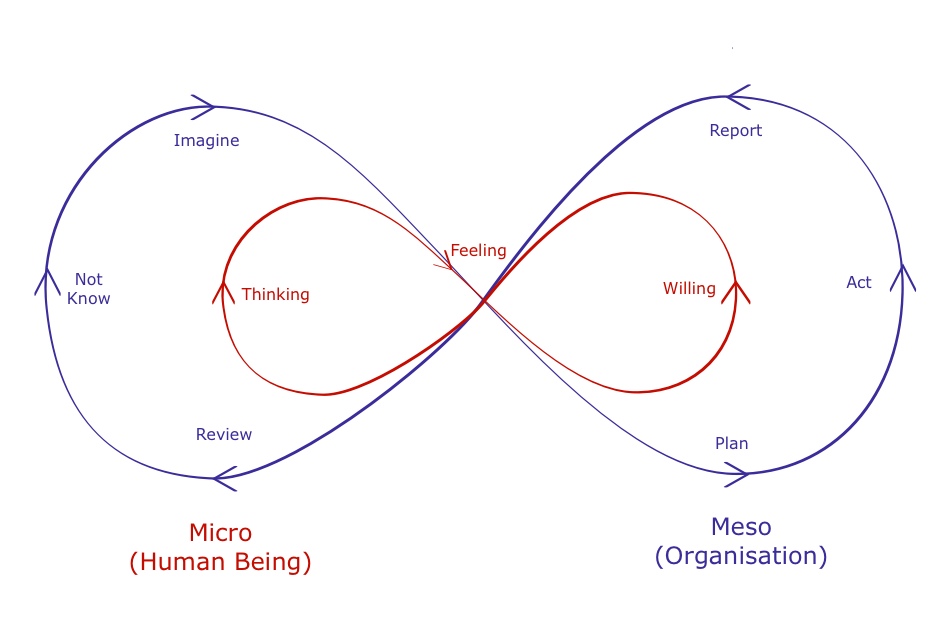
It's all inspired by Anthroposophy, and built up from Thinking Feeling Willing.  We might call it Participative, Michaelic Leadership.

Michaelic implies accountability.  Participative implies collaboration.  On the one hand everything is decided together, or in different but appropriate togethernesses.  On the other hand the management is authorised to make sure the agreements are carried out.
Here is another thought movement diagram.


Modern leadership requires thinking, feeling and willing.  The thinking aspect is what people usually mean by the narrower meaning of "Leadership".  Think of a group of people on a hike.  Across the bog is a mountain.  The leadership is to say "let us cross the bog to the mountain", the management is the job of getting everyone across the bog together, then up the mountain.  On the way different obstacles will call forth leadership moments.

We have a new thought, supported by research out of practical Anthroposophy, that there is a middle task, Facilitation.  In order for the leadership - management axis to be effective, a facilitation process is required.

So the groups meet in layers of increasing executive duty. Starting with the board or ownership container and ending with the executive or departmental meetings.

All the time facilitated discussion is working towards agreements that, once made, are then held to account for being carried out as agreed.

Facilitation Techniques:
  1. Gather evidence first and carry on gathering until you can't bear it any longer.
  2. Then ask what the solution might be.
  3. Give everyone a voice, and unless they are inputting data, an equal voice.
  4. Check in how people feel at the start, end and in between if it is a big process.
  5. Try to write it up as you go. At key points, read back for agreement.
  6. Every decision is made when everyone feels it is right. Not thinks it is right.  If a majority decision, then it is because a majority felt it was right.  Decision making is "Founding with our Hearts" and has to be feeling based, after thoughtful deliberation.
  7. When checking if actions are carried out (accountability), it is all about what was done.  This step is "what we would direct with our heads".
Steps 1-3 were inspired by The Philosophy of Freedom, R.Steiner.
Steps 4 and 5 were inspired by Edward de Bono and many other business gurus.
Steps 6 and 7 are inspired by The Foundation Stone Meditation, R.Steiner.

The Foundation Stone Meditation 

The Foundation Stone Meditation is a practical guide that encompasses the whole of Anthroposophy.  Many have taken it in to their lives and have found it helpful in many ways. 

In terms of working together in organisations we might experience the first verse, Spirit Recollection, to be about reviewing.  The third, Spirit Meditation about decision making, and the fifth, Spirit Vision about planning.  

The middle verse, decision making / Spirit Meditation is also the place where our meetings are managed.  In that regard, the emotions that well up and have to be contained in order that good work is achieved, can be thought of in terms of glimpses of the "surging deeds of world evolution...", and the result is: "Unite thine own I with the I of the world". In other words, our planning is woven, through the decision, in to the carrying out of the Will, thus the world is transformed, or made.

Saturday, October 2, 2010

Leadership Workshop

Tom Ravetz and I recently ran a workshop on leadership from an Anthroposophical point of view. Tom and I have both attended BME and have developed an interest in systemic and group relations concepts, and we both work out of an interest in Anthroposophy. Tom is in fact a priest in the Christian Community (he is the Lenka, which means he is the Priest responsible for the UK region).

In these notes from that event there are refences to the works of Steiner and references to Lucifer and Ahriman. Who are they? Maybe you think of them as the Devil and Satan... perhaps you could think of them as two temptations: either to do nothing and just float in luxurious abandon, or to become so utterly absorbed in the specific matter that a connection is lost to the whole.

I hope that this blog can be enjoyed as an experience of the struggle to understand and then frame that understanding in a way that is useful in real life.


Notes on Leadership

Following a day workshop in 11th September, 2010

Notes written by Tom Ravetz and Sebastian Parsons

Finding out what to do

In the Philosophy of Freedom, Rudolf Steiner describes 3 stages that lead to our doing something:
· Moral intuition where we conceive the idea
· Moral phantasy where we imagine how it could work
· Moral technique where we bring the idea into reality

Thinking and imagining (the first two stages) are gifts of Lucifer, and when we work with them we have to resist the temptations of Lucifer (arrogance, vanity, delusion). Having good ideas tempts us to underestimate the struggle of bringing them to earth. We have to grapple with our own shadow, our fantasies and projections, and we meet the double of pride and delusion.
Making something happen inevitably involves us in human institutions - temporary ones like an ad hoc planning meeting, and / or permanent ones, like a company. For this paper, we will call any grouping of people working towards a commonly-held purpose a system. The moment we are involved in a system, other dimensions of reality come into play with an exponential increase in complexity. Now we bring our own shadow-side into relationship with those of the other people, and they become the objects of our projection and fantasy. We encounter too the being of the group itself, the whole which is greater than the sum of its parts, which in turn has a shadow, an unconscious, and a higher being - the angel of the group.


The moral technique needed for bringing ideas into reality in systems is the understanding of how groups and organisations work. The reality of power and what works unconsciously in groups takes us into the realm of Ahriman. In this realm, we are tempted to become cynical or to despair and give up trying to make our ideas come into reality. When we go through this temptation, we are following Christ in his ‘descent into hell’ on Holy Saturday.
When thinking of ourselves as human beings there is a tendency to form a picture that is rather one-sided. Either:
· we think that we are only angels, that we only have to have an ideal and we will be able to achieve it. This leads to being out of touch, and in extreme cases to hypocrisy and fragmentation.
· we think that we are only animals, purely the products of genes and external conditioning. This leads us to become cynical about any prospect of truly working towards ideals.


As striving individuals we know that we need to integrate all parts of ourselves. This is never about finding the fixed position where we have everything in the right proportion; it is about understanding the different forces at work in us and accepting our movement between them, continually seeing where we are on the continuumn and accepting that we will need to move on.

Life-experience tells us too that when we ignore our deepest emotions and motivations, we get cut off from our power. Only when I acknowledge that I am jealous do I go through the process - humiliating though it feels at first - of finding out what I am lacking and getting in touch with my deepest desires.


Rudolf Steiner spoke about this in his lectures about the incarnation of Ahriman, given in the time of his greatest activity in trying to bring about something new in the social life.

It all amounts to this, that modern man only speaks truly of himself when he says that he hovers perpetually between two extremes: between the Ahrimanic on the one side, where he is presented with an outer delusion, a Fata Morgana, and, on the other, the Luciferic element within him which induces the tendency to illusions, hallucinations and the like. The Ahrimanic tendencies in man to-day live themselves out in science, the Luciferic tendencies, in religion, while in art he swings between the one extreme and the other. ... And then, vacillating between all this, there are the people who want to be neither the one nor the other, who do not rightly assess either the Luciferic or the Ahrimanic but want to avoid both. — “Ahriman — no! — that I must not, will not do, for it would take me into the realm of the Ahrimanic; that I must not, will not do, for it would take me into the realm of the Luciferic!” They want to be virtuous, avoiding both the Ahrimanic and the Luciferic.


But the truth of the matter is that Lucifer and Ahriman must be regarded as two scales of a balance and it is we who must hold the beam in equipoise.

And how can we train ourselves to do this? — By permeating what takes Ahrimanic form within us with a strongly Luciferic element. What is it that arises in modern man in an Ahrimanic form? It is his knowledge of the outer world. There is nothing more Ahrimanic than this knowledge of the material world, for it is sheer illusion. Nevertheless if the Fata Morgana that arises out of chemistry, out of physics, out of astronomy and the like can fill us with fiery enthusiasm and interest, then through our interest — which is itself Luciferic — we can wrest from Ahriman what is his own.

That, however, is just what human beings have no desire to do; they find it irksome. And many people who flee from external, materialistic knowledge are misconceiving their task and preparing the best possible incarnation for Ahriman in earth-existence. Again, what wells up in man's inmost being to-day is very strongly Luciferic. How can we train ourselves rightly in this direction? — By diving into it with our Ahrimanic nature, that is to say, by trying to avoid all illusions about our own inner life and impulses and observing ourselves just as we observe the outer world. Modern man must realise how urgent it is to educate himself in this way. Anyone who has an observant eye in these matters will often come across circumstances of which the following is an example.

A man tells him how indignant he is with countless human beings. He describes minutely how this or that in a, in b, in c, and so on, angers him. He has not an inkling that he is simply talking about his own characteristics. This peculiarity in human beings was never so widespread as it is to-day. And those who believe they are free of it, are the greatest culprits. The essential thing is that man should approach his own inner nature with Ahrimanic cold-bloodedness and dispassion. His inner nature is still fiery enough even when cooled down in this way! There is no need to fear that it will be over-cooled.
...
What I have just said may make you think that all these matters are very paradoxical. But in reality they are not. It is man who is paradoxical in his relationship to truth. What he must realise — and this is a dire necessity to-day — is that he, not the world, is at fault. Nothing does more to prepare the path for Ahriman's incarnation than to find this or that tedious, to consider oneself superior to one thing or another and refuse to enter into it. Again it is the same question of finding the point where everything is of interest. It is never a matter of a subjective rejection or acceptance of things, but of an objective recognition of the extent to which things are either Luciferic or Ahrimanic, with the result that the scales are over-weighted on the one side or the other.

To be interested in something does not mean that one considers it justifiable. It means simply that one develops an inner energy to get to grips with it and steer it into the right channel.

GA 191 II 2.11.1919

I wonder whether we could apply this to our relationships when working in groups. There, we encounter an Ahrimanic world that needs our enthusiasm and idealism ‑ the gifts of Lucifer. If we ignore the unconscious and shadow realities of groups, we are falling into the same error as when we want to ignore our own anger, jealousy and other less palatable emotions. However we speak even less about the fact that groups have these aspects than we do about our individual shadow-sides; there is much light to be shone into group (or organisational) life with a deepening of awareness and consciousness.


Doing this empowers us by overcoming any tendency to think that we are the idealists, cut off from the problems of the nasty world. When we grapple with the realities of groups, we are in touch with the same world that seems so far away when we criticise politicians and other leaders.
There is strong evidence that historically, anthroposophically-inspired institutions have been strong on moral intution and moral phantasy, but weaker on moral technique.
This manifests in many ways:


· a reluctance to acknowledge the political dimension, and what rises from this, a lack of interest in it;
· an allergy to the word leader, and the making 'leader' mean the same as 'tyrant';
· a tendency to tolerate secret leadership groups, power cabals, and group bullying and scape-goating;
· polarised thinking about such issues, for example:
· either we believe in the spirit, and uphold the idea against all the evidence that human beings are only motivated by their consciously stated ideals,
· or we are reductionists saying that there is only power politics.


Recent developments in some anthroposophical institutions have given more evidence for this one-sidedness. The move to employ professional managers could be seen as making institutional the divide between power and ideals that existed before. Now that there has been time to accumulate experiences and reflect, this becomes more apparent. The employed managers state their admiration for the ideals held by the staff, and their dismay at the social and political reality: cliques, bullying, lack of effective mirroring and mentoring.
The staff describe a reality where the managers want to solve everything with regulations and rules.


Each side can easily feel the victim of the other, and in some instances there have been tragic breakdowns of trust. Turning the situation around and seeing a challenge instead of a threat, an opportunity instead of a dead-end, we might see the following openings:
· the managers might choose to find out more about the founding ideals of the institution and see in them the resources needed to work to their purpose of helping the institution to work well;


· the staff might look at the world through the managers' eyes and use this as a tool to hold themselves to account.
· Both parties might discover a need to describe more clearly what the purpose of the institution is, so that the arguments are around what will serve that purpose and not around an endless reworking of assumptions and habits.
I remember hearing staff working in an anthroposophical institution in the 90s telling me how relieved they were that the authorities had forced them to have proper procedures for reporting stress in the workplace, with legislation for free time etc. Publicly those same staff would bemoan the fact that the authorities were stopping them from living according to their ideals.

The Goetheanism of Groups
Goetheanism tries to find the way of looking which is appropriate for the thing being looked at. In
The Theory of Knowledge Implicit in Goethe's World Conception, Rudolf Steiner describes how one can train oneself to find ways of looking. He makes a huge distinction between the tools we need to look at nature, and what is needed to look at Man. Looking at Man, we are beholding the being that has within it to create new laws. He goes a step further when he speaks of the fact that human beings are social creatures. Their humanity unfolds in wider systems:
But the human being does not belong only to himself; he also belongs to society. What lives and manifests in him is not merely his individuality but also that of the nation to which he belongs. What he accomplishes emerges just as much out of the full strength of his people as out of his own. With his mission he also fulfills a part of the mission of the larger community of his people. The point is for his place within his people to be such that he can bring to full expression the strength of his individuality. This is possible only if the social organism is such that the individual is able to find the place where he can set to work. It must not be left to chance whether he finds this place or not. It is the task of ethnology and political science to investigate how the individual lives and acts within the social community. The individuality of peoples is the subject of this science. It has to show what form the organism of the state has to assume if the individuality of a people is to come to expression in it. The constitution a people gives itself must be developed out of its innermost being. …


The constitution of a people, however, is nothing other than its individual character brought into a definite form of laws. A person who wants to predetermine the direction a particular activity of a people has to take must not impose anything upon it from outside; he must simply express what lies unconsciously within the character of his people.
(Chapter 18: Psychological Knowing Activity)


Rudolf Steiner spoke here about the widest ‘system’, the people, of which we are all part. What he says holds true however of every system – every grouping of human beings working towards a commonly-held purpose. Saying that there are dimensions of our experience in groups that we are at first unaware of; that there are motivations that spring from unconscious depths – is not the same as saying that we are purely determined by these factors. It is precisely in the meeting of our ideals with the realities that psychology describes that the struggle with Arhiman takes place.

If the gifts of Lucifer were enough to guarantee that our moral intuitions became reality, every institution based on Anthroposophy would have no problems. Facing those problems can make us feel a deep despair, particularly if we are unwilling to acknowledge that they will inevitable exist.

However, if we see what we encounter in working with groups not just as a problem but as a challenge that will allow us to develop new faculties, there is hope. The world into which we enter ‑ Ahriman's realm ‑ is the place that most urgently needs redemption in our time. We can experience a Christian task - the task of facing, acknowledging, learning and integrating this realm into our striving.

Understanding leadership
What is it about the concept of leadership that arouses such strong feelings?
We explored some of the words we associate with “leader”:
· old-fashioned
· arrogant
· follower
· (blind) obedience
· dictator
· charismatic leader


We remembered a model that we had encountered in anthroposophical circles of evolving modes of leadership: in Ancient Egypt pyramidal; in ancient Greece / Rome democratic; in the Consciousness-Soul consensual. Historical evidence flies in the faces of this; after all, Plato saw enlightened despotism as the ultimate form of leadership.

The work of Daniel Goleman suggests a different quality for our time. This would be that there is a process not of succession but of accretion, ie that one style doesn't replace the last but is added to it. He makes it clear that successful leaders can move between different leadership styles. They range from commanding to consensual, so could be placed on a continuum from pyramidal to community (see this summary). This works well with the image of the Consciousness Soul not as a fixed state, but as a willingness to move on a continuum, to oscillate or, to use Adam Kahane's image, to walk.

Another quality was brought in when we looked at the concept of containment. The leader's task is to make a safe container for the inevitable tensions that exist in groups, eg the tension between freedom and directedness. The strength of the leader can make a safe space in which consensus can unfold. If the leader uses his or her authority to make it clear that everyone is called to speak, to contribute; if he or she is not frightened of conflict, but allows the issues to be addressed, showing that he or she is interested not in siding with one or the other party to achieve some personal objective, but in making a space where an honest process can take place, trust will grow and the group will take up its agency and make good decisions.

This is not the same as saying that the leader does not, or cannot have a view, belong to one side or the other. In reality, the leader usually does have a view! However, if that view is stated along with everyone else as part of the process, then transparency and trust are actually enhanced. Alongside this there is a deeply experienced but rarely noticed paradox between the freedom of being an individual and the directedness of working in a group or team to a specific purpose. The desire to resolve this paradox without conflict arising underlies much of what has already been discussed and always results in more conflict and conflict that is often veiled and therefore all the more painful.

How a leaders supports a group in managing the tension between freedom and directedness has a lot to do with the space that is given for sharing views and the authority that is deployed to ensure the discussion resolves to a purposeful outcome. This authority could come through a simple rule such as in the case of a tied vote the leader will have a casting vote, or in the case that a consensus cannot be formed the leader will decide. Rules such as this provide a boundary within which the discussion can blossom in an open, frank and creative way, and it is exceptionally rare that such a contained process produces an outcome cannot be owned by everyone.

Something that was touched on but not overtly discussed, and perhaps deserves to be discussed more in the future, is the way a leader has a responsibility to the thought of the enterprise, and therefore the spirit-being of the enterprise. The leader is a lens through which that thought shone in to the world and the decision of who should be the leader is an important one (no kidding!). The deeply experienced fears, conscious and unconscious, around the appointment of a leader can, in themselves, prevent such an appointment ever being properly made. However, if the purpose is clear and the leader is consistent, then the question of how the organisation works in detail recedes in importance. Through the many psychological / spiritual gestures of human interaction, harmony and transformation can be achieved by any endeavour that is consistently managed and is directed by a clear purpose.

When we dig a bit deeper into the matter of consistency and purpose and it begins to become apparent that the success of an endeavour is deeply connected with its founding impulse. We have experience of many organisations and institutions that have disintegrated when their activity has ceased to be aligned to their founding purpose. It must be through the conscious / unconscious grasp that the human beings hold of the organisation that the authority of the founding gesture is mediated, and for those with a perspective informed by Anthroposophy, supported by the Spiritual World. The founding purpose can be rapidly intuited and the extent to which the current action is true to it can be deeply, intuitively and accurately grasped by team members. In every moment trust is growing or being eroded. In the light of this, the task of leadership begins to become clearer and the tools of Anthroposophy begin to seem very relevant.

Saturday, May 3, 2008

The Purpose of Anthroposophy


The Purpose of Anthroposophy

03 May 2008

Sebastian Parsons

Anthroposophy is a science which can be turned to use in helping people to transform and develop in their lives.  It is a science that sets out to grapple with the deeper, perhaps more mysterious aspects of being a human being – non-physical aspects such as consciousness, feelings, thoughts, and that vital spark – life itself.

Just as with a material science like physics for instance, Anthroposophy, also known as spiritual science, divides in to pure research and applied science.  In terms of the development of the pure science Rudolf Steiner contribution towers over all others so far.  That said, this is a very young science with Steiner its founder having died less than 100 years ago.  However, other students of Anthroposophy have been able to deepen and add to Steiner’s work. For example Bernard Lievegoed, Karl Koenig and Maria Thun.

The laws of physics are often revealed through the work of a genius such as Newton or Einstein, and in a similar fashion Steiner has outlined a number of “laws” of spiritual science.  These laws can and have been tested in the “spiritual laboratory” and once their usefulness has been established by an individual they can be brought to practical use in the world.

The “spiritual laboratory” differs from the physics laboratory in one crucial respect. Matters of the spirit can only be researched within the realm of the spirit, which means for us human beings, that it can only be researched within our own being.  Wherein lies the critical difference – our experience is individual and can not be experienced directly by another.  The instruments of the physics lab can be simultaneously witnessed by many people at once.  The instruments of the spirit lab are our own feelings and thoughts and these are not directly recordable by any instrument yet invented.

This means that Anthroposophy must be taken up by the individual, tested by the individual, and then worked with out of the individuals own and self generated conviction.  In this regard spiritual science appears rather more subjective than material science.  Such challenges are not faced by Anthroposophy alone.  Psychology, for example, observes human behaviour and asks questions in order to gather evidence.

The theorems of mathematics, the laws of quantum physics, the formulae of chemistry are not widely accessible. They are available to anyone who has the ability, the time and access to the necessary facilities – but otherwise the vast majority of people actually take the observations of scientists as truths, accepting that we cannot ourselves test them.

Anthroposophy however can be tested to our own satisfaction by anyone.  The spiritual science laboratory is our own consciousness in which we think and contemplate, consider and reflect.  We can test out different ways of using our spiritual faculties (thinking, feeling and willing) and use the evidence gained in developing our own relationship to the science of Anthroposophy.

The laws and proofs of spiritual science can be tested by anyone as the only requirement is to be a human being.  In reality though, the development of ones feelings, thinking and willing to be able to follow and test Steiner’s work for oneself does require ability, desire and determination.  Consequently, many of those who work with the fruits of spiritual science do so because the feel right, they take these laws as truth without knowing the proof, just as we do with normal material science.

This highly practical approach is vindicated by the most common place activities.  For example, when driving along in a modern car we are actually making use of the fruits of physics, chemistry and geology cultivated over several hundred years.  The fact that we are driving in the car is in a sense living proof of the understanding developed in the science that lies behind the car.

Similarly, to work in an environment that has been created using the fruits of Anthroposophy is to experience the living proof of spiritual science.  The technology developed out of Anthroposophy tends to be related to the life processes of society, for example: education, health, nutrition and business.

Which leads us to the question of the purpose of Anthroposophy.  What is the purpose of this spiritual science?  Edward de Bono, the writer and psychologist said “The purpose of science is not to analyse or describe but to make useful models of the world. A model is useful if it allows us to get use out of it.” That’s not to say that science doesn’t analyse or describe, but rather, that it does these things in order to provide an understanding that we can make use of in our lives.

I feel very comfortable with thinking of the purpose of Anthroposophy in these terms also.  Anthroposophy provides understanding that is found to be useful by people in living their lives. Whilst not apparently useful in the same way as a car, applied spiritual science is very helpful in creating all sorts of functional, supportive and productive human environments.  It is rather as if Anthroposophy kicks in when a task must be done but there is no way in which a machine could be made to do it.

A factory has the latest machinery but productivity is lower than it should be – Anthroposophy provides understanding about how human beings work together which can be applied to this situation to bring about the desired increase in productivity.

Children are learning in a classroom, but the we want to achieve more than filling them up with knowledge.  We want them to discover themselves during their school days so that they can join society as motivated, self reliant and caring adults.  Anthroposophy understanding about the development of the child has much to contribute to achieving this aim.

People become ill and sometimes it really seems as if their illness is the consequence of their lives.  A colleague has a cold and you catch it, or maybe you don’t.  It seems to depend on… what?  How stressed you are?  How tired you are?  How, deep down, the one thing you really need is a day in bed?  Anthroposophy has much to support the individual in using their illness to provide insights in to their wider health, and also as a springboard for personal growth and transformation.

But what was Steiner’s view of the purpose of Anthroposophy?  At a lecture in Zurich on the 29th of October, 1919, Steiner said “We shall now speak of these three regions of culture, art, science, and religion. For it is the mission of Anthroposophy or spiritual science to build up a new structure in these three regions of culture.” This very practical statement reveals how this spiritual science can be used in the areas of life that are separated from material science by a huge abyss.

Modern scientists would probably be deeply insulted to be put in the same category as art and religion!  A vociferous part of the material science community strives to present science to society as of primary importance, with art a valid but secondary part of life and religion an illusionary crutch for the weak minded.

However, Steiner’s view is clear that science, art and religion are equally important parts of our cultural life.  He sees how Anthroposophy can support art in providing spiritual inspiration, how religion can be reinvigorated to provide spiritual nourishment, and science expanded to bring Nature and the Human Being in to a more holistic harmony.

It is interesting to consider this idea that spiritual science can also offer something to material science.  A great deal of progress has been made by material science through the breaking apart of material substance in order to reduce it to a more fundamental level and in so doing reach a more fundamental understanding.  This reductionist approach has served us well, but great things are also possible from focussing on a wider or more holistic view.

Medicine and products can be created out of this holistic science, for example, the Dr.Hauschka skin care range which has a huge global reputation as a highly effective product.  This range was created out of understanding how the human being works and interacts with the environment and so is able to correctly identify and prepare the fruits of nature such as plants and minerals that are needed for good skin health.

At another lecture on the meaning of life given in Copenhagen in 1912, Steiner said “This must not be taken as a kind of moral sermon, but as the representation of a fact. It is a fact that productions springing from ambition and desire for renown give rise in our souls to such seeds as bring deformities to birth in the spiritual world. To suppress these and also gradually to transform them is a fruitful task for the far future. It is the mission of Anthroposophy to accomplish this task…”

The spiritual world is the world of non-matter.  It is the world of all our thinking, feeling and willing, and it is the world of spirit that lies beyond us.  This is traditional territory of religion, and it is when Steiner goes in to this territory that he is both at his deepest, spiritually speaking, and yet in a sense, at his most remote from the everyday life of our modern society.

Steiner is here describing the way in which our thinking and feeling life impacts on the whole spiritual realm.  The tools of Anthroposophy strengthen and develop our inner life – our spiritual life.  In so doing they will help us to become the Human Beings that the far future will need us to be.

There is much that the human being experiences that is in common with every other human being, and in this we are happy to share our experiences with each other.  Yet there are also many aspect of our being that feel very individual and which we are inclined to ignore and keep hidden.  Rudolf Steiner’s research in to spiritual science took him beyond the everyday experience that all human beings share of thinking, feeling and willing; body, soul and spirit.

His investigations categorised the layers of our living being, our daily consciousness, and below and above our daily consciousness.  He charted how our thinking and feeling can be developed in to sensitive organs of spiritual perception.  These matters go beyond our commonplace everyday experience, but they are of helpful in understanding some of the exceptional circumstances that we encounter.

Those times when we act on the spur of the moment and change the course of our whole lives.  Those times when we experience or witness things that we know are impossible and yet which we know happened – super-human strength in the midst of disaster for instance, or the experience many people have of looking down on themselves from outside of their own body.  Those transcendent moments when we know that there is a dimension to our being the surface of which is barely scratched by our everyday reality.

Anthroposophy has a very long way to go – as the human being evolves as a social being, so too will the science of the spirit.  Anthroposophy will now travel with mankind for the rest of time.  The work of Rudolf Steiner will provide a resource and reference point for scientists of the spirit today and in the future.  His huge written and spoken output provides a research resource – as a mine of information, and as a checkpoint for spiritual scientists as they develop their skills.

Applied spiritual science which offers so much to the modern person grappling with modern life is also only in its infancy.  Along with us, it has a future of transformation and development as it supports us human beings as we face the ultimate challenge – being human.

I would like to conclude with a very practical statement of the purpose of Anthroposophy.  The purpose of Anthroposophy is to support human beings in living more fulfilled lives.  At a deeper a level, by so doing, it supports our evolution and transformation.  Perhaps the biggest evolutionary challenge the human being is facing at the moment is our burgeoning freedom.  More and more the social rules and laws of the past are falling away.  The church no longer has the power to control and social conventions are being thrown off willy-nilly.

No matter how much people may long for some long gone world of regulation and conformity, we could not turn back the clock, even if that world existed.  The challenge is to find a way to act as individuals so that we experience and create a society of  trust and support for each other. Perhaps the most fundamental purpose of Anthroposophy is to give us the tools we need to take hold of our new found freedom and so “Lead ourselves” in our own meaningful and fulfilled lives.