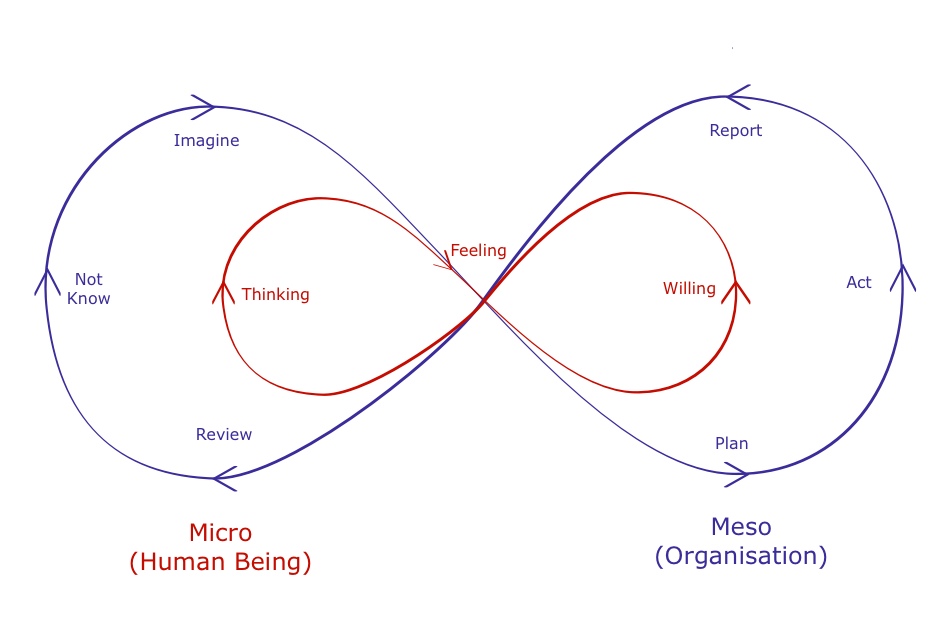
The meeting establishes the evidence and makes decisions. The key task is always prioritisation. List are maintained. These are "Project" and "Action" Lists for ongoing work and "Safe Spaces" lists for projects and ideas that can not be done yet.
It's all inspired by Anthroposophy, and built up from Thinking Feeling Willing. We might call it Participative, Michaelic Leadership.
Michaelic implies accountability. Participative implies collaboration. On the one hand everything is decided together, or in different but appropriate togethernesses. On the other hand the management is authorised to make sure the agreements are carried out.
Here is another thought movement diagram.

Modern leadership requires thinking, feeling and willing. The thinking aspect is what people usually mean by the narrower meaning of "Leadership". Think of a group of people on a hike. Across the bog is a mountain. The leadership is to say "let us cross the bog to the mountain", the management is the job of getting everyone across the bog together, then up the mountain. On the way different obstacles will call forth leadership moments.
We have a new thought, supported by research out of practical Anthroposophy, that there is a middle task, Facilitation. In order for the leadership - management axis to be effective, a facilitation process is required.
So the groups meet in layers of increasing executive duty. Starting with the board or ownership container and ending with the executive or departmental meetings.
All the time facilitated discussion is working towards agreements that, once made, are then held to account for being carried out as agreed.
Facilitation Techniques:
Steps 4 and 5 were inspired by Edward de Bono and many other business gurus.
In terms of working together in organisations we might experience the first verse, Spirit Recollection, to be about reviewing. The third, Spirit Meditation about decision making, and the fifth, Spirit Vision about planning.
The middle verse, decision making / Spirit Meditation is also the place where our meetings are managed. In that regard, the emotions that well up and have to be contained in order that good work is achieved, can be thought of in terms of glimpses of the "surging deeds of world evolution...", and the result is: "Unite thine own I with the I of the world". In other words, our planning is woven, through the decision, in to the carrying out of the Will, thus the world is transformed, or made.
So the groups meet in layers of increasing executive duty. Starting with the board or ownership container and ending with the executive or departmental meetings.
All the time facilitated discussion is working towards agreements that, once made, are then held to account for being carried out as agreed.
Facilitation Techniques:
- Gather evidence first and carry on gathering until you can't bear it any longer.
- Then ask what the solution might be.
- Give everyone a voice, and unless they are inputting data, an equal voice.
- Check in how people feel at the start, end and in between if it is a big process.
- Try to write it up as you go. At key points, read back for agreement.
- Every decision is made when everyone feels it is right. Not thinks it is right. If a majority decision, then it is because a majority felt it was right. Decision making is "Founding with our Hearts" and has to be feeling based, after thoughtful deliberation.
- When checking if actions are carried out (accountability), it is all about what was done. This step is "what we would direct with our heads".
Steps 4 and 5 were inspired by Edward de Bono and many other business gurus.
Steps 6 and 7 are inspired by The Foundation Stone Meditation, R.Steiner.
The Foundation Stone Meditation
The Foundation Stone Meditation is a practical guide that encompasses the whole of Anthroposophy. Many have taken it in to their lives and have found it helpful in many ways.In terms of working together in organisations we might experience the first verse, Spirit Recollection, to be about reviewing. The third, Spirit Meditation about decision making, and the fifth, Spirit Vision about planning.
The middle verse, decision making / Spirit Meditation is also the place where our meetings are managed. In that regard, the emotions that well up and have to be contained in order that good work is achieved, can be thought of in terms of glimpses of the "surging deeds of world evolution...", and the result is: "Unite thine own I with the I of the world". In other words, our planning is woven, through the decision, in to the carrying out of the Will, thus the world is transformed, or made.
